Medical records in English: EMR, EHR, and vocabulary that matters
Discover which terms to use to translate medical records into English, when to prefer EMR or EHR, and six practical examples of phrases and abbreviations.

Medical record in English: EMR, EHR and key vocabulary
In most contexts, "cartella clinica" is translated as medical record or medical chart, terms that are virtually interchangeable in current usage. If you are referring to a specific episode, such as a hospitalization, the most natural term becomes case sheet or patient record; for digital versions, however, the acronyms EMR (electronic medical record) and EHR (electronic health record) are used. The right choice always depends on the context: who is writing, who they are addressing, and what type of document they are translating.
In brief:
The most appropriate translation of cartella clinica is generally medical record or medical chart, depending on the context and the healthcare setting.
It is essential to clarify acronyms like EMR and EHR, distinguishing between a single facility's electronic record and a shared history across multiple healthcare facilities.
For terms like anamnesi, referto, and lettera di dimissione, it is preferable to use medical history, report, and discharge summary, always considering the target audience.
Translations of medical documents with legal value require certified translation and, in some cases, apostille or legalization, relying on translators with proven clinical experience.
Consistency in structured data and clarity in abbreviations facilitate accurate translation, reducing ambiguity and interpretative errors.
Index
Medical record in English: main variants and when to use them
Medical history, report, and discharge letter in English
Electronic medical record: EMR vs. EHR
Practical examples: how to translate the most common phrases
When a specialized sworn translation is needed
Clearer clinical data, more accurate translations
What to really look at before translating a medical record
Sources
Medical record in English: main variants and when to use them
The two most common translations, according to the Collins Dictionary, are medical record and medical chart. The former is generic and applies to almost any written context, from correspondence between doctors to administrative documentation. The second, medical chart, is more typical of the American hospital environment and refers to the physical or digital document kept at the patient's bedside during hospitalization.
Patient record shifts the focus to the patient rather than the document itself: you often find it in computer systems or consent forms, where the emphasis is on who owns the data, not how it is organized. Case sheet and case history, on the other hand, are used for specific clinical episodes: a surgical procedure, a short hospitalization, a specialist visit with its relative follow-up.
There are also two less frequent but useful variants to know:
Clinical record: preferred in British contexts and academic texts, almost synonymous with medical record but with a more formal register.
Hospital records: in the plural, it indicates the entirety of the documentation produced during a hospital stay, not a single document.
WordReference confirms this usage distribution, pointing to medical record and medical chart as the reference translations even in the most frequent collocations.
Medical history, report, and discharge letter in English
Around the medical record revolve terms that are mistranslated more often than the main document. Here are the most reliable correspondences:
Anamnesi: the literal translation is "anamnesis", correct but rarely used outside specialized texts. In daily clinical practice, the natural term is medical history, which appears in questionnaires and data collection forms for patients, as confirmed by the clinical definitions of anamnesis.
Referto: this translates to report, but if you are referring to a specific exam it is more precise to speak of test result or test report.
Lettera di dimissione: becomes discharge summary in formal clinical settings, or discharge letter when the document is addressed to the family doctor or the patient themselves.
The rule of thumb is simple: use technical vocabulary (anamnesis, clinical record) when writing for other healthcare professionals, and prefer simpler formulations (medical history, patient record) when the recipient is the patient or an administrative office.
Electronic medical record: EMR vs. EHR
EMR (electronic medical record) refers to the digital version of the medical record kept by a single practice or department: it collects diagnoses, treatments, and prescriptions relating to that specific facility. EHR (electronic health record) has a broader scope: it aggregates data from multiple healthcare providers, designed to be shared among different hospitals, laboratories, and specialists.
The practical difference lies in data portability. If you are translating documentation for a dental practice that only manages its own patients, EMR is almost always the correct term. If, on the other hand, the document refers to a system that integrates data from multiple healthcare facilities, EHR is the more precise choice. Other useful terms in this context: patient summary for a concise overview of the clinical history, and digital patient record as a generic alternative when the specific acronym is not required.
Practical examples: how to translate the most common phrases
Here are some typical phrases found in a medical record and their most natural translation in English:
«Il paziente presenta anamnesi di ipertensione» becomes «The patient has a history of hypertension»: literal translation of anamnesi is avoided in favor of history, which is more idiomatic.
«Cartella clinica aggiornata al controllo del 12 marzo» is rendered as «Medical record updated as of the 12 March follow up».
«Referto radiologico negativo» translates to «Radiology report negative», keeping report because it refers to a specific exam.
«Lettera di dimissione con indicazioni terapeutiche» becomes «Discharge summary with treatment instructions».
«Paziente in trattamento per HTN» requires attention: HTN is a clinical abbreviation for hypertension, which should be expanded to «hypertension» if the recipient is not a doctor.
«Consulto specialistico richiesto» is rendered as «Specialist consultation request».
Abbreviations are the most delicate part of any medical translation: acronyms like HTN, DM (diabetes mellitus) or COPD (chronic obstructive pulmonary disease) must always be expanded when the text is intended for the patient, while they can remain unchanged in correspondence between professionals. The register changes everything: a report for the family doctor tolerates technical terms, while a document for the patient does not.
When a specialized sworn translation is needed
A simple translation is enough for personal use or to share information with another doctor. Things change when the document needs to have legal value, for example for an insurance claim, a change of residence, or a request for a second opinion abroad that requires official validity.
In these cases, a sworn translation (asseverazione) is needed: the translator swears before a judicial official that the translation is faithful to the original, and the document receives a stamp and an oath statement. If the record is to be used outside the European Union, legalization or an apostille is often also required, which certifies the authenticity of the translator's signature for foreign authorities.
Documents that typically require a sworn translation:
Medical records for disability claims or insurance compensation.
Documentation for international medical transfers.
Reports to be presented in legal proceedings abroad.
To choose a competent medical translator, verify three things: prior clinical experience or specific training in medical terminology, the use of updated industry glossaries, and written guarantees of confidentiality regarding patient data.
A tip: before entrusting the record to a translator, always ask for an example of previous work on medical documentation: the quality of the terminological rendering is better evaluated from a concrete sample than from a quote.
Clearer clinical data, more accurate translations
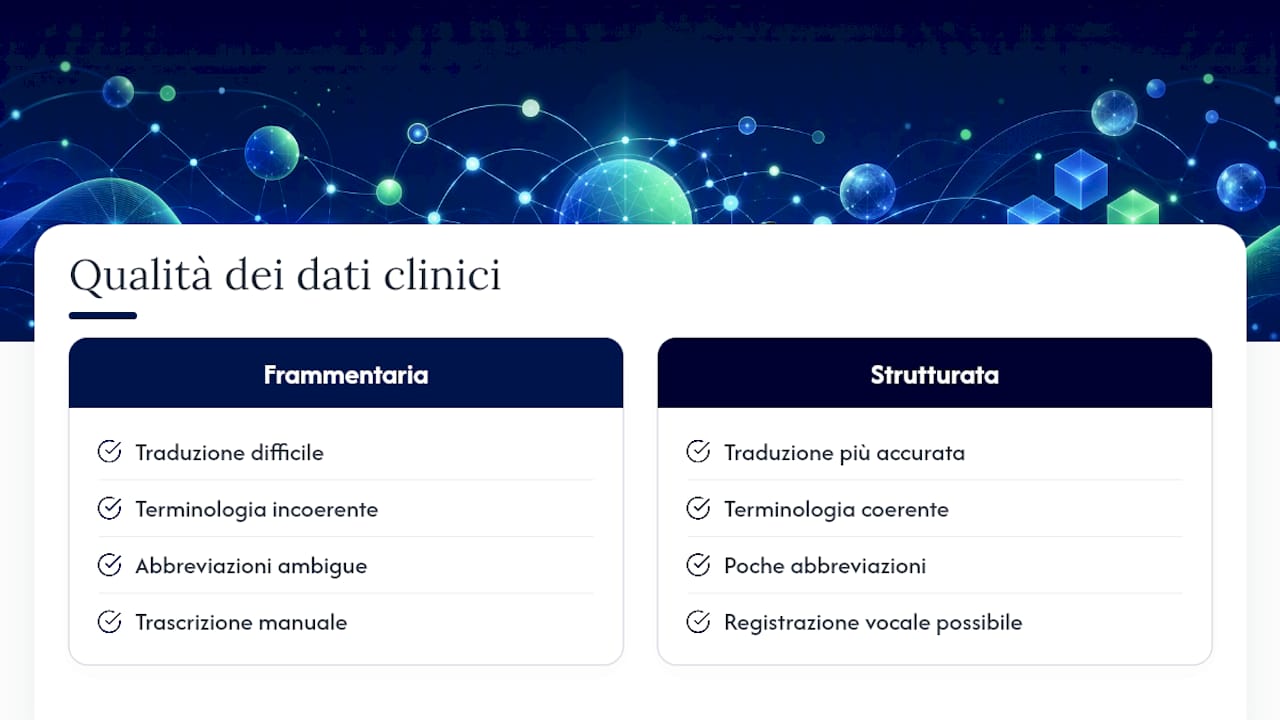
A medical record filled out in a fragmentary way or with ambiguous abbreviations is difficult to translate well, regardless of who is handling it. The importance of an accurate medical history for patient safety also applies to the translatability of the document: structured and consistent data reduce the ambiguities that a translator would otherwise have to interpret.
AI-assisted voice capture tools, like those integrated into Treatbase, allow the medical history to be recorded during the visit without manual transcription, maintaining more consistent terminology from one patient to another. A medical record with structured data from the moment of entry reaches the translator with fewer terminological ambiguities and fewer improvised abbreviations, which significantly simplifies the work of those who must render it in English.
What to really look at before translating a medical record
A quick checklist is worth more than a thousand generic tips. Before assigning or completing a translation, verify: 1) terminological consistency between entries, 2) expansion of every clinical abbreviation, 3) drug names written in full, 4) identification data translated correctly, 5) signed consent forms attached, 6) appropriate register for the final recipient.
— Matteo
Sources
To verify translations and collocations, Collins and WordReference remain the most solid references, while PMC delves into the clinical role of medical history. For examples of contextual use, Reverso Context offers real sentences taken from authentic texts.
English translation of “CARTELLA CLINICA” | Collins Italian-English Dictionary
cartella clinica - Italian-English Dictionary | WordReference