3 essential documents for GDPR in the dental practice
Practical guide to making your dental practice GDPR compliant: essential forms, operational checklist, minimum security measures, and how Treatbase...

3 Essential Documents for GDPR in the Dental Practice
To adapt a dental practice to GDPR, you immediately need an updated privacy notice, the record of processing activities, minimum security measures, and a privacy officer. The Regulation (EU) 2016/679 and the Privacy Guarantor remain the reference points to follow, but the real difference is made by the principle of accountability: demonstrating, with concrete documents, that the practice actually manages data as it claims to do.
In brief:
It is essential to update the privacy notice, the record of processing activities, and to adopt concrete security measures, even for practices with few members.
The management of health data requires a solid legal basis, explicit consent for purposes other than treatment, and attention to secure communication channels.
Minimum security measures must include differentiated passwords, encrypted backups, regular updates, and controlled physical access.
The record of processing activities and a Data Protection Impact Assessment (DPIA) are mandatory for large-scale or innovative processing, even in small practices.
Proper data management directly affects clinical quality and patient trust, so compliance must be integrated into daily work with suitable digital tools.
Table of Contents
Forms and Practical Checklist for the Dental Practice
What Health Data Does a Dental Practice Process and on What Legal Basis?
What Minimum Security Measures Does Article 32 of the GDPR Require?
Record of Processing Activities and DPIA: What Is Really Needed in a Dental Practice
What to Do in Case of a Data Breach in the Dental Practice
Who Does What: Roles, Appointments, and Contracts with Suppliers
Digital Tools That Simplify Compliance in Dentistry
Privacy as Part of Care, Not as a Separate Bureaucratic Task
Treatbase: Compliance That Integrates into Daily Work
Sources
Forms and Practical Checklist for the Dental Practice
Every practice needs three basic documents, always consistent with one another: the privacy notice, the consent form for data processing, and the appointment letters for external processors. None of these work well if copied from a generic template: compliance requires analyzing the practice's real data flows, not the automatic adoption of a model downloaded online, as highlighted in the Consulcesi guide on dental privacy.
What the minimum documentation must contain:
Privacy notice: purposes of processing, legal basis, retention periods, rights of the data subject, and contact details of the data controller.
Consent to data processing: separate from the clinical informed consent, with a specific checkbox for secondary purposes such as reminders via SMS or email.
Appointment letter for external processors: dental laboratory, accountant, cloud software provider.
Access log: who consults medical records and when, useful in case of an inspection.
A quick checklist to keep on the desk: notice updated to the latest regulation, signed consent form for every active patient, signed and archived contracts with suppliers, monthly updated access log.
What Health Data Does a Dental Practice Process and on What Legal Basis?
Health data in a dental practice includes clinical records, X-rays, intraoral photos, laboratory reports, and medical histories. These are special categories of data according to Article 9 of the GDPR, and their management requires more attention than standard personal data. Sending reports via WhatsApp or other unsecure messaging apps remains one of the most frequent critical points, as pointed out in the Make Me Smile guide on health data.
For healthcare purposes, the legal basis is Article 9, paragraph 2, letter h) of the GDPR: separate consent is not required for diagnosis and therapy, because processing is necessary for healthcare provision. However, explicit consent is required when data is used for different purposes: commercial reminders, marketing, sharing with insurance companies at the patient's request. Clinical informed consent, governed by Law 219/2017 and the Gelli-Bianco Law, remains a distinct act from privacy consent, as explained in the Consavio guide on informed consent in dentistry: keeping them separate avoids confusion in case of an inspection.
What Minimum Security Measures Does Article 32 of the GDPR Require?
Article 32 of the GDPR does not list specific tools, but requires measures "appropriate to the risk." In a dental practice, this translates into concrete and verifiable actions.
Individual and role-differentiated passwords: each collaborator accesses only the data necessary for their function, never with shared credentials.
Regular and encrypted backups: digital medical records and X-rays must have automatic backup copies, not just on an external drive in the practice.
Constant software updates: practice management software, operating system, and antivirus must be updated as soon as a patch is available.
Controlled physical access: locked paper archives, workstations with locked screens when unattended.
Periodic staff training: secretaries and assistants must know how to recognize a phishing attempt or an anomalous data request.
A tip: Set up a quarterly check of security measures, even just for half an hour: make sure backups are actually working and that no collaborator is still using a shared password.
Record of Processing Activities and DPIA: What Is Really Needed in a Dental Practice
The record of processing activities is mandatory for practices that process health data, regardless of size: even a practice with two chairs and three collaborators must keep it updated and ready for an audit, as recalled by the Marketing Odontoiatrico guide on GDPR in dental practices.
The record must indicate at least these items:
Purpose of the processing (care, billing, appointment reminders).
Categories of processed data and categories of data subjects.
Individuals who have access to the data, both internal and external.
Expected retention periods for each category of document.
Security measures adopted for each processing activity.
A Data Protection Impact Assessment (DPIA) becomes recommended when the practice introduces new monitoring technologies, video surveillance systems in the waiting room, or large-scale processing of health data across multiple connected locations. For retention, medical records and reports generally follow the timeframes indicated by specific healthcare regulations, often exceeding ten years: it is advisable to check case-by-case with your privacy officer.
What to Do in Case of a Data Breach in the Dental Practice
A data breach is not just a cyber attack: it can be an email sent with the wrong attachment or a lost USB drive containing a patient's X-rays. The procedure to follow is always the same.
Contain the incident: isolate the compromised system, revoke access if necessary, stop the spread of data.
Assess the risk: understand how many patients are involved and what data is exposed, medical records or only personal details.
Notify the Guarantor within 72 hours of discovery, if the risk to the rights of data subjects is real, as required by current regulation.
Inform the affected patients, if the risk to them is high, using clear language about the exposed data and the measures adopted.
Document everything: date, cause, corrective measures, even when notification to the Guarantor is not necessary.
Many violations in the healthcare sector stem from unsecured messaging channels or unencrypted backups: acting on these two points significantly reduces a major part of the real risk.
Who Does What: Roles, Appointments, and Contracts with Suppliers
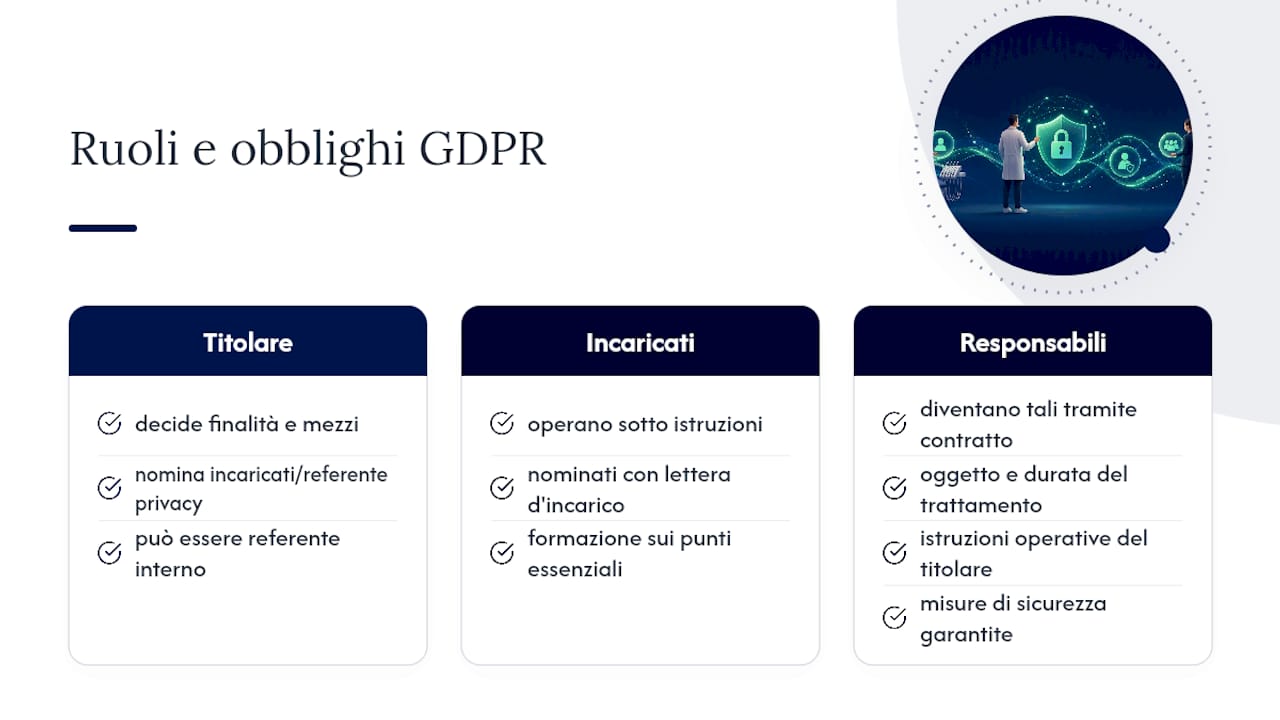
The owner of the practice decides the purposes and means of processing; collaborators are authorized persons and operate under instructions; external suppliers (dental laboratory, cloud software, accountant) become data processors through a specific contract. An external DPO is not necessarily required: for many practices, it is sufficient to appoint an internal privacy officer, often the owner themselves or the office manager, trained in the essential points of the GDPR.
Every appointment letter or contract with an external processor must state: object and duration of the processing, operational instructions from the controller, security measures guaranteed by the supplier, and methods for returning or deleting data at the end of the relationship. Anyone who organizes practice data with a clear method is already starting with an advantage on this front.
Digital Tools That Simplify Compliance in Dentistry
A well-designed dental software significantly reduces the manual work associated with privacy: centralized management of consents, tracking of who accesses what, automatic backups, and reminders that do not go through unsecure channels. Systems of this type can automate the audit trail and consent management, reducing the margin of human error compared to a paper archive or Excel sheets scattered across various computers.
Treatbase integrates digital signature and archiving of consents, permission management for collaborators, and an automatic patient reminder system, elements directly linked to the requirements of Article 32. The section dedicated to patient data management shows how consents and records remain centralized in a single environment, rather than scattered between paper and disconnected digital files.
Before choosing any cloud provider, always check these three points:
Is there a Data Processing Agreement (DPA) contract?
Is the data stored on servers within the European Union?
Does the provider guarantee clear contractual clauses on security and data deletion?
Privacy as Part of Care, Not as a Separate Bureaucratic Task
Many owners treat the GDPR as a compliance task to be filed away once a year, just in time for a potential inspection. This is a mistake of perspective. Proper management of health data is as much a part of clinical quality as the sterilization of instruments: a patient who discovers their X-rays were sent to an unsecured WhatsApp group loses trust in the practice, not just in the reception desk that made the mistake.
I recommend setting up a structured, not improvised, annual review: record of processing, contracts with suppliers, staff training. The internal privacy officer should have real time to do this, not just the title on paper. The pages dedicated to visit management offer a concrete starting point for understanding where the most sensitive data flows in a practice originate.
— Matteo
Treatbase: Compliance That Integrates into Daily Work
Many dental practices tackle the GDPR with scattered sheets, paper files, and an email archive that no one actually checks. A well-designed dental software can reduce this invisible work by bringing consents, medical records, and collaborator permissions inside a single cloud system, with digital signature of consents and automatic tracking of who accesses what.
Data migration from the old software can be simple and fast, allowing the practice to continue operating while the historical archive is transferred. The payment management and automatic billing features work alongside patient reminders, reducing both manual errors and time spent on repetitive tasks. If you want to understand how it works in practice for your clinic, request a demo from the Treatbase homepage and decide calmly if this is the right time to simplify privacy management along with the rest of your daily work.
This article provides general information and does not replace the advice of a qualified doctor. Consult a qualified healthcare professional regarding your specific case before taking action based on this content.