Dentist voice commands: when they are really needed and how they work
Discover how in-office voice commands streamline medical records and hands-free control of the dental unit, with human verification.

Dentist voice commands: when they are truly needed and how they work
Voice commands integrated into the practice management software allow you to fill in the clinical record and control the dental chair hands-free, reducing downtime and physical contact during the visit. They work well for dictation, scheduling, and activating peripherals, but require supervision for numbers and complex terminology. Human verification remains necessary before any data enters the record.
In brief:
The most reliable voice systems reduce clinical terminology errors to a minimum thanks to pipelines that combine automatic speech recognition and linguistic correction, but human verification remains essential.
Voice recognition technologies optimized for dentistry must be integrated with the structured data of the management software, otherwise transcriptions still require a lot of review.
Audio quality highly depends on directional or pin-type microphones and the acoustic environment of the practice, with accuracy also improved thanks to preliminary tests with real sentences.
Before adopting voice commands, it is necessary to verify where the data is processed, ensure there is a privacy impact assessment, and that encryption and logging measures are implemented.
Treatbase natively integrates voice artificial intelligence for the automatic completion of clinical records, with free data migration and no hidden costs.
Treatbasetreatbase.comFill in the record by voiceTreatbase integrates voice artificial intelligence into dental practice management software, to document visits without manual transcription.Discover Treatbase
Table of Contents
Practical use cases in the clinic: where voice commands make a difference
How the technology works: ASR, LLM correction, and integration with management software
Accuracy, clinical risks, and mitigation measures
Compliance and privacy: what to check before adopting voice commands
Hardware, microphones, and environment: best practices for reliable performance
Operational checklist to implement voice commands in a practice (concrete steps)
Why consider Treatbase: practical capabilities and social proof
Author's perspective on the future of voice commands in dentistry
How to get started with Treatbase and useful links
Sources
Frequently Asked Questions
Practical use cases in the clinic: where voice commands make a difference
Voice commands do not replace clinical judgment, but they simplify the mechanical part of documentation. For example, the dentist can dictate observations and diagnoses in real time while working four-handed, with immediate transcription without interrupting the procedure.
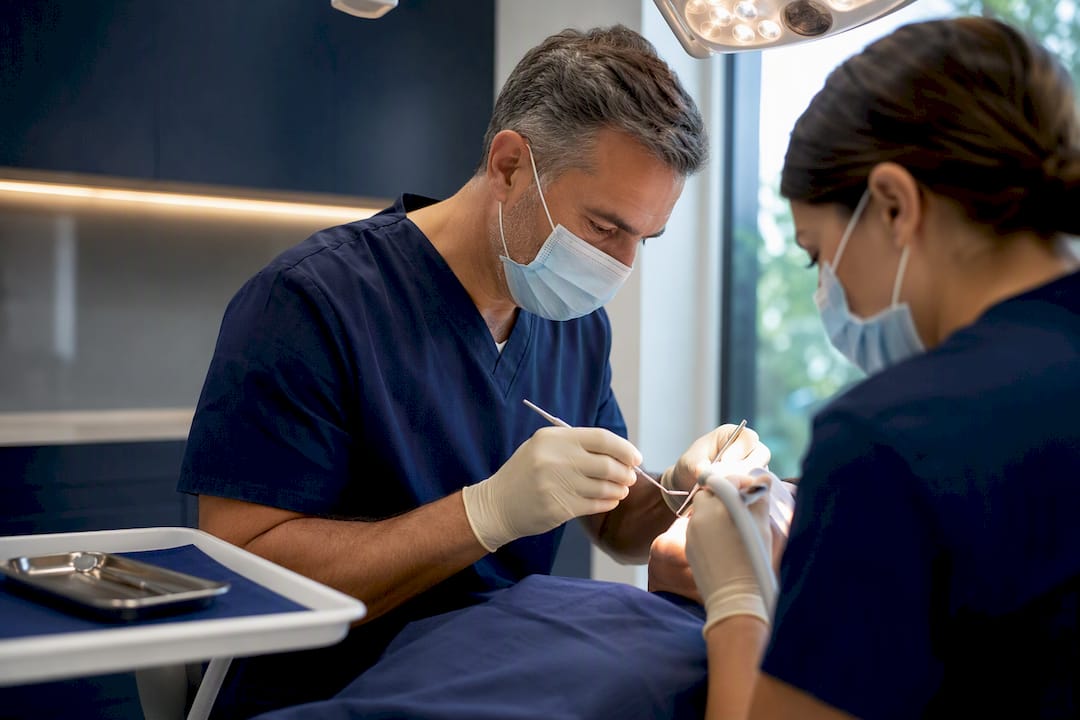
Dental chair control represents another concrete area. Activating the lamp, adjusting the height of the chair, or changing tools by voice reduces contact with surfaces during hygiene protocols, an aspect already present in some new generation dental equipment.
Other mature uses in practice:
Schedule and reminders: schedule, move, or confirm appointments by voice while escorting the patient out.
Periodontal charting: dictate probing values (depth, bleeding, mobility) without taking hands off the instrument.
Peripheral activation: control the suction, mouthwash syringe, or operating light with short voice instructions.
Quick administrative notes: record reminders by voice for the reception desk or annotations to be reviewed after the session.
Not everything should be moved to voice. Definitive diagnostic decisions, treatment plan selection, and final signing of the chart remain manual actions, with visual review of the transcribed text. The same goes for entering complex billing codes, where a recognition error generates direct financial consequences. The most tangible impact concerns hygiene protocols: fewer keyboards and switches touched during the session means fewer surfaces to disinfect between patients, a benefit already reported in recent developments of dental chairs.
How the technology works: ASR, LLM correction, and integration with management software
A voice command in dentistry is never just a simple transcription. At the core is an automatic speech recognition (ASR) engine that converts audio into text. Alone, however, a generic ASR makes systematic errors in clinical terms, tooth numbering, and specialized abbreviations because it has not been trained on that vocabulary.
For this reason, the most reliable pipelines add a second level: a language model (LLM) that corrects the raw text, recognizing patterns typical of dental language and correcting terminology errors. An experimental study on ASR pipelines and ASR with LLM correction applied to clinical documentation measured a Domain Word Error Rate (DWER) for the corrected pipeline that was significantly lower compared to isolated ASR systems, with a substantial reduction in clinical terminology errors in the reported comparison.
This second level of correction makes the difference between a system usable in the clinic and one that generates more review work than it saves. The often underestimated component is the third: integration with the structured clinical database of the practice management software. Without a direct connection to the fields of the medical record (teeth, quadrants, procedure codes), even a technically correct transcription ends up as free text to be reclassified by hand.
The typical workflow follows these steps:
Audio acquisition via a dedicated microphone during the visit.
ASR transcription of speech into raw text.
Contextual correction using a language model trained on dental vocabulary.
Mapping to structured fields of the medical record (tooth, surface, procedure).
Presentation to the clinician for verification before confirmation.
A tip: before choosing a system, always ask for a demo using real phrases from your practice, not the provider's presentation script: that is where terminology errors show up.
Accuracy, clinical risks, and mitigation measures
No current voice system guarantees perfect transcriptions in a clinical setting. The most critical errors are those that are plausible and difficult to detect, such as an incorrect tooth number, reversed laterality, or imprecise measurement values.
The Domain Word Error Rate drops to 3.5% with ASR pipelines corrected by LLM, compared to higher values in isolated ASR systems: a substantial improvement, but not an elimination of risk. The same study indicates that clinically significant errors persist even in the highest-performing pipelines, which is why human verification remains necessary before any data enters the record.
Concrete mitigation measures include:
Mandatory on-screen review of the transcribed text before confirmation, never an automatic signature.
Highlighting of low-confidence words by the system, so the clinician knows where to look more closely.
Structured inputs for numerical data (teeth, quadrants, probing measurements) instead of free phrases, to reduce ambiguity.
Double check for billing, since an error here has immediate financial consequences.
The practical rule for a clinic evaluating this technology is simple: treat the voice output as a draft to be confirmed, not as already validated data. Pipelines with linguistic correction drastically reduce the review workload compared to a generic ASR, but they do not eliminate it.
Compliance and privacy: what to check before adopting voice commands
Voice data collected in a dental clinic is health data, and this entirely changes the framework of responsibility. Before signing a contract with a provider, there are checks that cannot be skipped.
Ask where the audio and text are processed: on-device, on servers in the European Union, or on extra-EU infrastructures, because this determines the applicable legal regime.
Verify the existence of a DPIA (data protection impact assessment) specifically for this processing, not a generic one.
Check encryption and logging: audio data must be encrypted in transit and at rest, with access traceability.
Verify storage times and methods, with minimization criteria that avoid the accumulation of unnecessary recordings.
Request regulatory compliance documentation, including guarantees provided for artificial intelligence systems considered high-risk.
The Decalogue of the Privacy Guarantor for AI-based healthcare services indicates exactly these technical and organizational measures as a requirement, not as an optional choice. At the European level, the regulations on artificial intelligence systems classify systems that affect health into risk categories, requiring providers to demonstrate compliance for high-risk ones.
A tip: get a look at the provider's Data Processing Agreement (DPA) before the pilot test, not after: it is the document that establishes who is liable in the event of a breach.
Hardware, microphones, and environment: best practices for reliable performance
The quality of voice recognition depends more on hardware and the acoustic environment than many providers would have you believe during sales. A study on speech recognition applied to periodontal probing compared different types of microphones in real clinical conditions, finding that pin-type microphones achieve higher accuracy than stationary microphones, with complete recognition rates remaining limited, between 36% and 52% under the tested conditions, when the sentence mixes numbers and technical terms.
Some practical indications for the clinical environment:
Prefer pin-type or directional microphones worn close to the mouth, rather than stationary microphones at a distance.
Isolate background noise: suctions, turbines, and background conversations significantly degrade system performance.
Test audio quality before the pilot, with typical phrases from the practice (tooth numbers, surfaces, frequent procedures).
Dedicate a stable audio channel on the local network in practices with multiple stations, to avoid interference between different chairs.
A practice with multiple chairs active at the same time requires a network configuration designed specifically for this, not a simple shared Wi-Fi connection: anyone needing support for this type of integration can contact digital development and integration agencies with experience in dedicated networks.
Operational checklist to implement voice commands in a practice (concrete steps)
Adopting voice commands without a method almost always leads to one of two outcomes: abandonment after a few weeks or accumulation of undetected errors. An orderly sequence reduces both risks.
Initial assessment: map out which activities in the practice truly benefit from voice (dictation, schedule, charting) and define measurable KPIs.
Limited pilot plan: test the system with only one operator and a limited number of patients for two or three weeks.
Staff training: teach short, structured phrases, avoiding ambiguous or excessively long sentences.
Integration and technical testing: verify that dictated data flows correctly into the structured fields of the visit management software.
Post-pilot metrics collection: rate of manually corrected errors, saved documentation time, staff satisfaction.
Rollout decision: extend to other stations only after validating the results of the pilot.
A tip: set numerical thresholds before starting the pilot (for example, how many errors per session are acceptable), otherwise the final evaluation becomes a matter of opinion, not data.
Why consider Treatbase: practical capabilities and social proof
The software integrates voice artificial intelligence to simplify the completion of clinical documentation. The system covers the entire practice workflow, not just dictation.
The concrete features available include voice completion of clinical records, hands-free periodontal charting, invoice management, patient reminders, practice performance monitoring, and the possibility of data migration from the previous system.
Those evaluating adoption can request further information on interoperability with their existing database, staff training times, and data processing policies before deciding.
Author's perspective on the future of voice commands in dentistry
The technical direction is clear: the best systems will not be those that understand the most, but those that know when they do not understand and ask for confirmation. A voice engine that signals its uncertainty is worth more than one that guesses confidently. The real leap in quality will not come from more "conversational" assistants, but from deeper integration with the structured data of the medical record. Before generalizing, test in a limited context and measure real errors.
— Matteo
How to get started with Treatbase and useful links
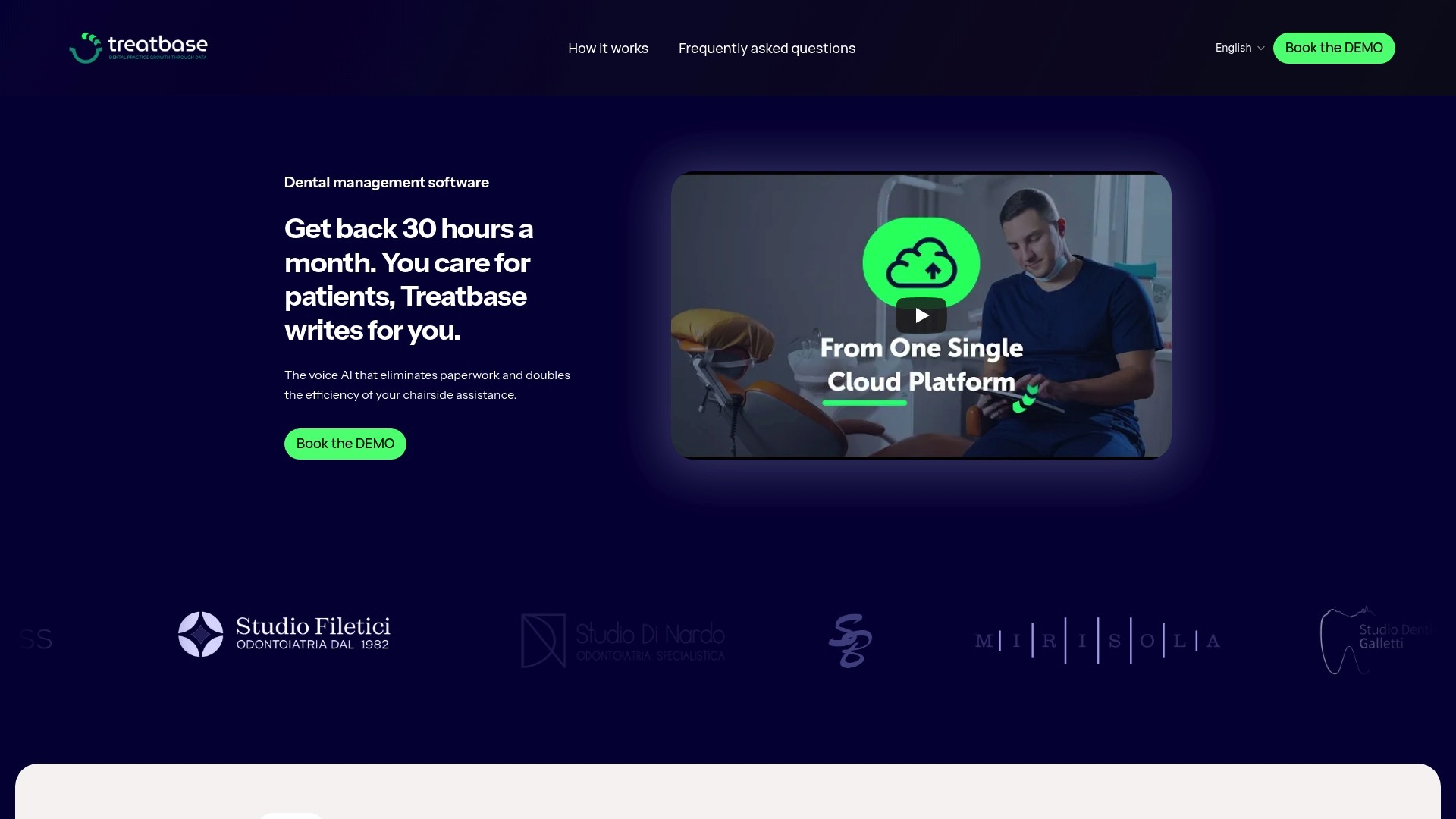
Switching to voice commands does not require completely changing the way your practice works: it requires choosing a system that integrates with what you already do, without hidden migration costs. Treatbase offers free data migration and voice management of the clinical record along with billing, scheduling, and reminders in a single platform.
Before contacting the sales team, prepare:
The list of current systems (management software, patient database, billing) to be migrated.
The number of stations and users that will use the voice system.
The operational priorities of the practice, to understand which features to activate first.
Those who want to see the platform in action can request a demo directly on the dental practice management software page.
This article provides general information and does not replace the advice of a qualified doctor. Consult a qualified healthcare professional regarding your specific case before taking action based on this content.
Sources
Experimental study on ASR and ASR+LLM pipeline in clinical documentation (KCL manuscript)
Study on speech recognition for periodontal probing (voice in clinical setting) - e-HIR
EU text - regulations and guidelines for AI systems (relevant excerpts)
Frequently Asked Questions
What are voice commands for dentists and what are they used for?
They are systems that recognize the clinician's speech and convert it into text or actions inside the management software, for example, filling in the clinical record or activating the dental chair without using hands. They are mainly used for dictation, charting, and schedule management during the visit.
Are voice commands accurate enough to replace manual writing?
Pipelines that combine voice recognition and linguistic correction greatly reduce errors compared to simple systems, but clinically significant errors still persist. Because of this, human verification before confirmation in the chart remains necessary, not optional.
What privacy data must be checked before adopting a voice system?
It is necessary to verify where the audio data is processed, if there is a data protection impact assessment (DPIA), and if the provider applies encryption and access logging, as indicated in the Privacy Guarantor's guidelines. Documentation of compliance with European requirements for high-risk artificial intelligence systems must also be requested.
What kind of microphone is needed to use voice commands in the clinic?
Pin-type or directional microphones worn close to the mouth offer better results than stationary microphones, according to clinical evaluations on speech recognition. Background noise from suctions and turbines remains one of the factors that most degrades system performance.
Does Treatbase already include voice commands in its management software?
Yes, Treatbase integrates voice artificial intelligence directly into the software to fill in the clinical record, manage hands-free periodontal charting, and automate billing and reminders. Data migration from the previous system is free and does not require additional costs.