Voice-enabled medical records: how to speed up reports in the clinic
A voice-based medical record converts dictation into structured reports, accelerates workflow, and explains technical integration, privacy, and selection criteria.

Voice medical record: how to speed up reports in the practice
Yes, a voice medical record transforms dictation directly into a report within the system, drastically cutting reporting times compared to manual typing. The doctor speaks, and the software translates and structures the text into the correct fields of the electronic medical record. The rest of the article covers technical integration, privacy obligations, and practical criteria for choosing the right system.
In brief:
Voice dictation allows for faster and more readable digital reports, eliminating manual transcription times and reducing errors.
To ensure interoperability with the Electronic Health Record, the system must export data in standard formats like HL7-FHIR and offer documented APIs, without contractual lock-ins.
It is crucial to assign individual accounts and logging systems to comply with GDPR and ensure operational accountability in shared user environments.
Before purchasing, check the accuracy of the voice engine on clinical terminology, the integration with the EHR, and the possibility of data migration without hidden costs.
Systems like Treatbase integrate dictation, clinical management, billing, and digital signature, optimizing the entire workflow of the dental or medical practice.
TreatbaseSpeeds up the voice medical recordTreatbase transcribes voice into the medical record and integrates clinical management, billing, and reminders for the dental practice.Discover Treatbase
Table of Contents
Why reporting weighs so heavily on the clinical day
Operational checklist: how to dictate a report without losing quality
How to connect dictation to the Electronic Health Record
Privacy and GDPR: what changes with voice dictation
How to evaluate a voice medical record before buying it
The perspective of those closely following the digitization of practices
Treatbase: integrated voice dictation in practice management
Sources
Frequently Asked Questions
Why reporting weighs so heavily on the clinical day
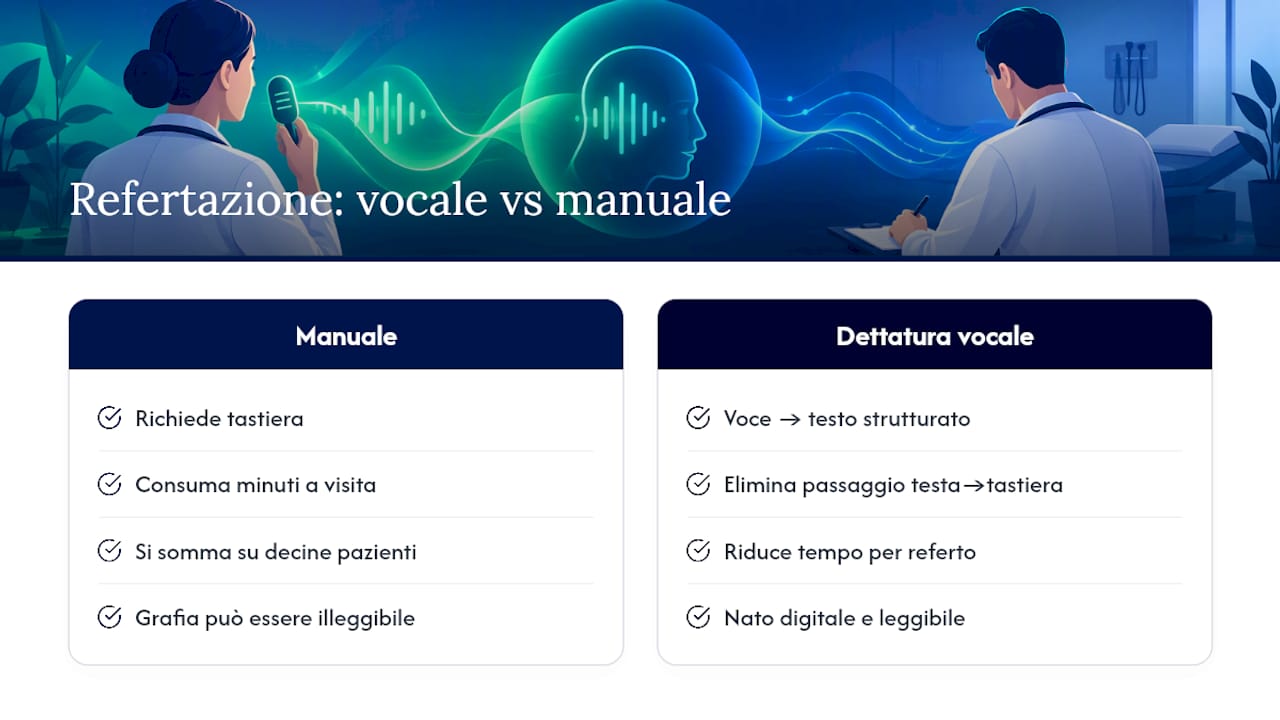
Every visit produces a report, and every report written by hand or typed via keyboard consumes minutes that add up over dozens of patients a day. Voice dictation steps in right here: it eliminates the step from head to keyboard and replaces it with a direct flow from voice to structured text.
There is also a regulatory constraint that is rarely mentioned when discussing speed. The patient has the right to access their medical record and receive it in an intelligible form: if the handwriting is illegible, the data controller must provide a typewritten transcription. An automatically dictated and transcribed report solves the problem at its root, because it is born already readable and already in digital format.
Operational checklist: how to dictate a report without losing quality
Moving from pen to voice requires a method, not just a microphone. Here is the sequence that reduces errors and maintains the clinical quality of the document.
Activate dictation inside the report field, not in a separate document to be pasted later: the text must immediately go into the data structure of the electronic medical record.
Use a template per type of visit (first visit, follow-up, procedure) so the voice software automatically distributes anamnesis, physical examination, and treatment plan into the right sections.
Dictate in short, complete blocks, one clinical sentence at a time, so that subsequent review requires only minor adjustments and not a rewrite.
Proofread before signing, focusing on drug names, dosages, and technical terms: these are the points where voice recognition errs most often.
Sign digitally and archive in the format used by the practice, verifying that the final document is correctly linked to the patient's record.
A tip: Build a small personal dictionary of terms you use often (drug names, acronyms, practice protocols). Most voice systems allow you to teach specific pronunciations, and this alone cuts a major part of post-dictation corrections.
The weak point of many workflows is not the dictation itself, but the review left for the end of the day: correcting twenty reports together is slower and more tiring than correcting one immediately after dictating it.
How to connect dictation to the Electronic Health Record
A voice note transcribed well but trapped in a local file is of little use beyond the practice itself. For the dictated report to become useful data outside of one's own clinic, the medical record must talk to external systems, starting with the Electronic Health Record.
The national guidelines for the EHR 2.0 require interoperability and uniformity of content, not simply the existence of a digital archive. The record collects reports, discharge letters, and other essential clinical documents, and sharing them across different facilities depends on them being structured according to common standards.
Before choosing a dictation system, check these three points with the provider:
Whether the software exports data in HL7-FHIR format or equivalent, not just in PDF or plain text.
Whether there is a documented API to connect the medical record to the regional or national EHR.
Whether exporting patient data is free of charge and without contractual lock-ins in case of a provider change.
A system that transcribes well but remains isolated still creates a data silo, with all the transcription work having to be redone elsewhere.
Privacy and GDPR: what changes with voice dictation
The patient has a right of access to their medical record, and the data controller must provide intelligible data: this applies to GDPR just as much as to a handwritten record. Voice dictation, if managed well, simplifies this obligation because it produces text that is readable from the start.
The risk does not lie in the voice, but in the access permissions. A healthcare voice system should apply the data minimization principle, with permissions tailored by role: the practice assistant sees the schedule, not necessarily every clinical detail of the patient.
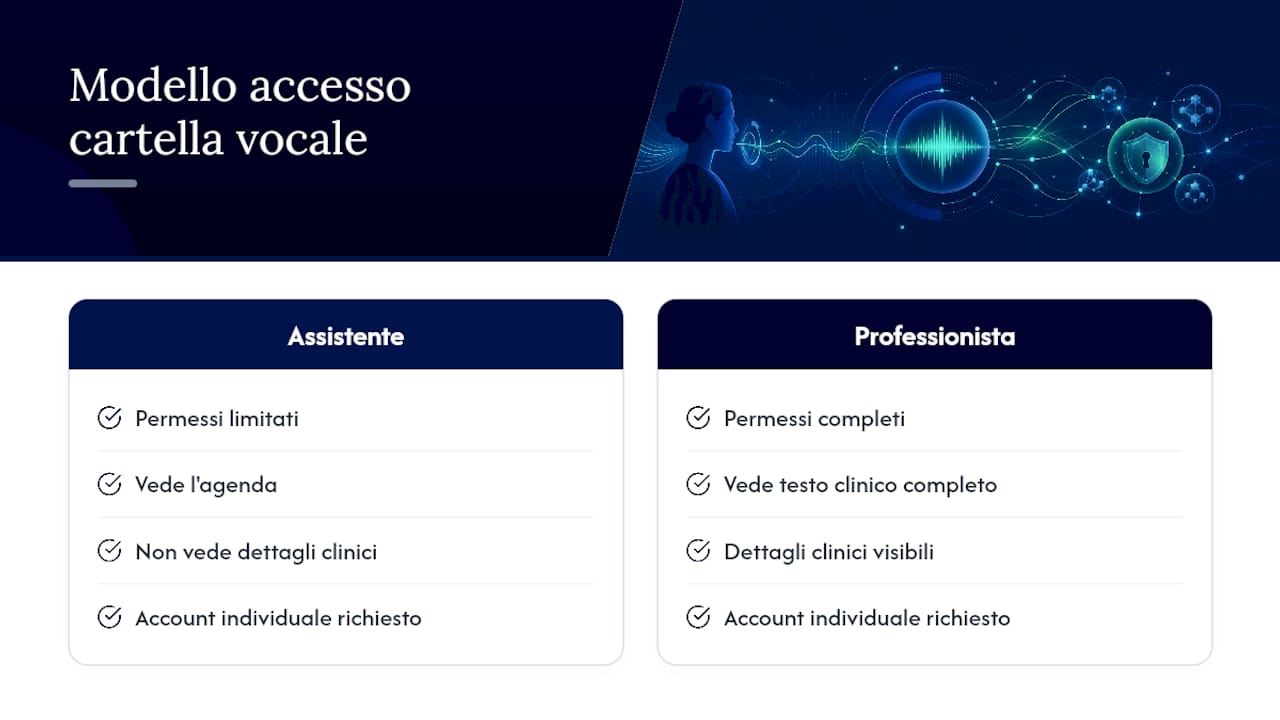
Statistics aside, the most practical risk is operational: shared accounts among multiple users make it impossible to reconstruct who wrote or modified what. The Privacy Authority explicitly highlights the need for personal accounts and traceable logging systems for accountability and audit purposes.
A tip: Always assign an individual account to every staff member, including for dictation. In case of an audit or dispute, being able to prove who dictated or edited a report is worth more than any other security measure.
How to evaluate a voice medical record before buying it
Not all voice dictation systems are the same, and the differences are seen especially in daily use, not in the sales demo. Before signing a contract, check these points with the provider:
Accuracy in medical Italian/English: an engine trained on specialized clinical terminology, not just generic language, drastically reduces manual corrections.
Real interoperability: exporting in standard formats and ability to connect to the EHR, not just generic promises of "compatibility".
Complete workflow: from dictation to template, from review to digital signature, all in the same environment without shifting between different software programs.
Data migration included: check if the transition from existing systems is free or involves hidden costs.
Role-based permission management: modular access that respects the data minimization required by the GDPR.
Support and assistance in your language, with clear response times in case of malfunction during clinical hours.
The return on investment is measured in hours recovered each week, not just in the monthly subscription price.
The perspective of those closely following the digitization of practices
Many practices adopt voice dictation thinking only of speed, and overlook interoperability: a fast report that is isolated from the EHR is only half the job done. The real question to ask is not "how fast is it", but "where does this data end up afterward". A system like Treatbase demonstrates that dictation, charting, and archiving can coexist in the same environment without intermediate manual steps.
— Matteo
Treatbase: integrated voice dictation in practice management
Some management software is designed to eliminate manual transcription in dental practices, integrating voice dictation into the clinical workflow, alongside hands-free periodontal charting, to optimize the overall time spent.
In addition to voice, some management systems include functions for billing, automatic patient reminders, and digital signature of consent forms, integrated into the same cloud environment. Data migration from previous management software may be provided as free and fast, a relevant detail when evaluating a software change. Anyone wishing to see the dictation workflow applied to a real case can consult the documentation on visit management or request a demo directly on the product page.
Sources
Frequently Asked Questions
Can the patient read the medical record?
Yes, the patient has the right of access to their medical record and the data controller must provide it in an intelligible form. If the handwriting is illegible, they have a right to a typewritten transcription.
How much does it cost to get the medical record?
Costs vary from facility to facility and depend on the type of copy requested (paper or digital). Regulations do not set a single national rate, so it is best to check directly with the relevant office of the healthcare facility.
What do I need to do to get the medical record?
Simply submit a written request to the facility or professional holding the data, exercising the right of access provided by the GDPR. Delivery can take place in paper or digital copy, depending on how the request is made.
How does the electronic medical record work?
It collects the patient's clinical data, including reports, in digital format, and makes them available for consultation according to permissions defined by role. When equipped with voice dictation, as is the case with systems like Treatbase, the transcription of the report goes directly into the data structure without intermediate manual steps.
How much does a voice medical record system like Treatbase cost?
The price is not published online and is available upon request by contacting Treatbase directly. Configuration generally depends on the number of workstations and the features activated in the practice.