Hands-free dentistry: voice-activated records and probing
How periodontal probing and voice-activated medical charts work: benefits, steps, software selection criteria, and privacy regulations in Italy.

Hands-free dentistry: voice-activated records and probing
In dentistry, working hands-free means completing the medical record without touching a keyboard, mouse, or pen. You state the values out loud as you probe, examine, or treat, and the practice management software records them in the right place. The difference is most noticeable during periodontal probing, where hundreds of numbers must be logged in just a few minutes. Here you'll find out how it really works and when it pays off compared to paper or an assistant transcribing. You'll also learn what to check before choosing voice software and which Italian regulations on privacy and professional roles you cannot ignore.
Treatbasetreatbase.comRecord the probing while you workTreatbase uses voice-based artificial intelligence to streamline charting and periodontal records.Discover Treatbase
In brief
Full-mouth probing is performed on 6 sites per tooth. Across 28 teeth, that's 168 probing depths, plus recessions, bleeding, and plaque. This is where dictation saves the most time.
Using voice, the hygienist or dentist works independently, without a second operator writing things down and without removing gloves to touch the computer.
The right software understands clinical Italian, allows for voice corrections, and displays values in real time so mistakes are spotted immediately.
Under GDPR, healthcare data requires enhanced protection. Always ask where it is hosted, who has access, and whether it is used to train artificial intelligence models.
Voice replaces the keyboard, not the clinician: the diagnosis and signature remain yours.
Table of Contents
What "hands-free" at the chairside means in practice
Why periodontal probing is the ultimate test
Paper, assistant, or voice: three methods compared
How a voice-dictated probing session works
What to check before choosing voice-activated management software
Privacy, artificial intelligence, and liability
Our perspective
Treatbase: clinical records and voice probing in a single management platform
Frequently Asked Questions
Sources
What "hands-free" at the chairside means in practice
In a traditional dental practice, clinical documentation follows three paths:
the clinician writes at the end of the appointment;
an assistant takes notes while the clinician dictates;
gloves are removed mid-examination to type.
All three come at a cost. Writing afterwards means relying on memory. Using an assistant means tying up two people for a single task. Touching the keyboard means breaking the chain of asepsis and changing gloves.
Working hands-free eliminates that middle step. A microphone—either on a headset or ambient—picks up what you say. Voice recognition converts it into structured data, and the software inserts it into the chart: probing depths, recessions, bleeding, mobility, and furcations, as well as clinical notes, completed procedures, and patient instructions.
The technology is not new. As early as 2005, the Journal of the American Dental Association noted that advances in voice recognition and microphones had made charting and dictating notes faster and more accurate than in the past. In recent years, artificial intelligence has entered the scene. Today, a voice system does not simply write down word for word: it recognizes context ("16 buccal, three two four, bleeding") and fills in the correct fields without forcing you into a rigid syntax.
Why periodontal probing is the ultimate test
According to the Italian Society of Periodontology and Implantology (SIdP), probing is the essential clinical procedure for periodontal diagnosis. It is carried out at standard locations, typically 6 sites per tooth: three buccal and three lingual or palatal. Do the math for a full dentition of 28 teeth: 168 probing depths and just as many recession or gingival margin values. Add to this bleeding on probing and plaque, site by site. From these numbers, clinical attachment level (CAL) is calculated and the examination is compared with previous ones.

Accuracy is not a trivial detail. The ADA cites clinical criteria from the American Academy of Periodontology stating that periodontitis is present, for example, when interdental clinical attachment loss is detectable at two or more non-adjacent teeth. A value entered in the wrong box can alter the diagnosis and staging, and consequently the treatment plan.
With paper or an assistant, the risk lies in the transfer: you read the probe, call out the number, and someone writes it down—perhaps on the adjacent site. Then there is bleeding. The proper method is to record it the moment it appears, not from memory at the end of the exam. When you dictate and watch the chart update on the screen, verification is immediate.
Paper, assistant, or voice: three methods compared
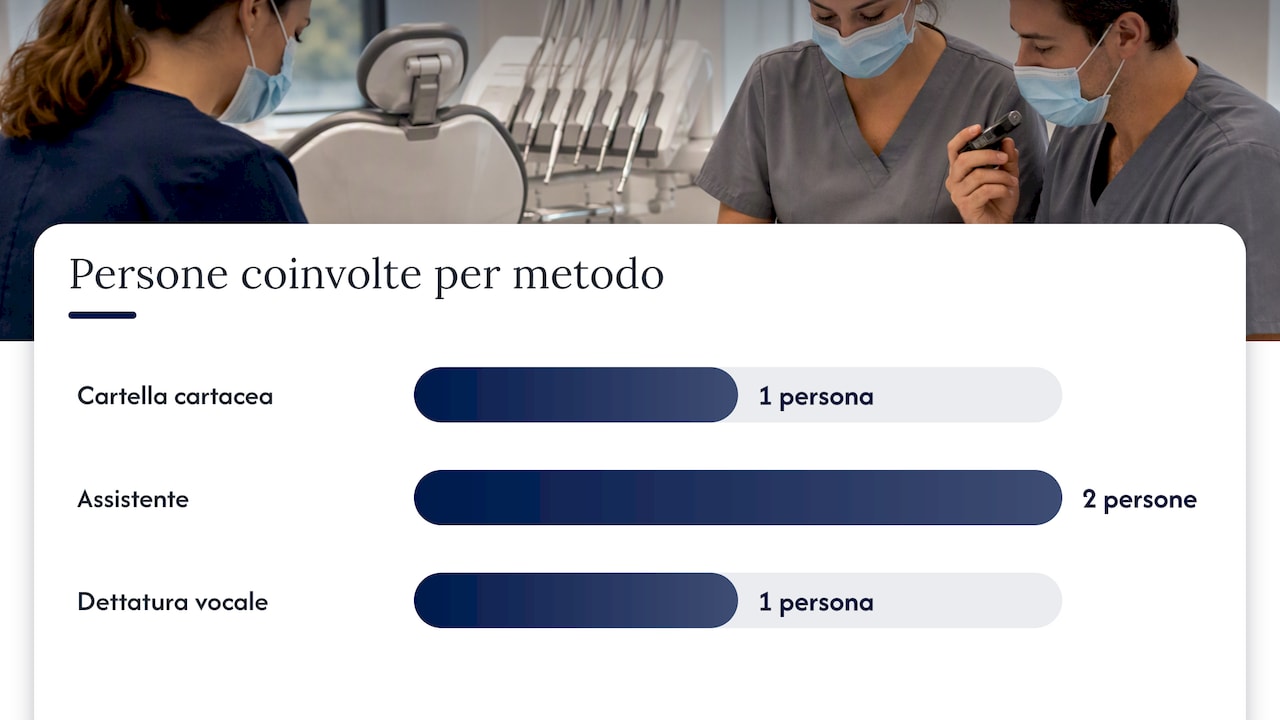
Criterion | Paper chart | Transcribing assistant | Voice dictation in software |
|---|---|---|---|
Staff required | 1, with pauses to write | 2 for the entire duration | 1 |
Gloves and asepsis | Frequent interruptions | No interruptions for the prober | No interruptions |
Risk of error | High: handwriting and copying | Medium: verbal miscommunication | Low, if the software displays values in real time |
Comparison with past exams | Manual, across different sheets | Depends on the software | Automatic, within patient history |
Storage | Physical, needs digitization | Digital | Digital and structured |
Learning curve | None | Low | A few sessions to get used to commands |
Dental Tribune, describing the digital periodontal chart, already emphasized that these software solutions eliminate the need for a second operator during recording. In a clinic with a single hygienist, the assistant can move to another chair instead of waiting beside the patient.
An honest note: the first voice-recorded exams might feel slower than paper. This is completely normal; you are breaking a well-established habit. It usually takes just a few sessions for the sequence of commands to become as second nature as moving the probe.
How a voice-dictated probing session works
The workflow varies slightly from software to software, but the typical sequence is as follows:
Open the patient's record from the calendar or file before putting on gloves. From that point on, you no longer touch the computer.
Start listening with a voice command or a foot pedal. Ensure the microphone is close to your mouth and away from the suction unit.
State the tooth and surface, for example "one six, buccal". Many systems then advance automatically along the standard path, so you only need to call out the numbers.
Dictate the three depths for the surface: "three, two, four". Immediately follow with any bleeding or suppuration the moment you see it.
Add recessions, mobility, and furcations when necessary, using short commands.
Correct by voice: if you make a mistake, a command like "correct" or "back" returns you to the previous site without touching anything.
Show the final chart to the patient. Comparing it with the previous exam motivates them far more than a sheet full of numbers.
Review and confirm before closing. The software transcribes, but responsibility for the record remains with the clinician.
The same principle applies outside periodontics: new patient notes, medical history, procedure descriptions, and completed treatments to be billed. Every minute not spent typing is a minute returned to the patient.
What to check before choosing voice-activated management software
Not all voice systems are created equal. Before signing up for a subscription, put them to the test on these key points.
Language and clinical vocabulary
The recognition engine must understand the terminology spoken in the clinic, including FDI tooth numbering, common abbreviations, and your accent. If the clinic has international staff or branches abroad, multilingual support is also vital. Request a real-world chairside trial, not a pre-recorded demo.
Noise and microphone quality
Handpieces, suction units, and ultrasonic scalers generate steady ambient noise. A good system filters out background noise and won't mistake a conversation with the patient for data to be recorded.
Correction and visual feedback
You must be able to see each value as soon as it is dictated and correct it by voice. A system that records "blindly" postpones error detection to the end of the exam, when it is much harder to catch.
Integration with the rest of the practice
Voice is only useful if the data isn't trapped in a silo. It needs to flow seamlessly into the patient's history, treatment plan, estimates, and billing without manual re-entry. A voice module disconnected from your core management software brings you right back to square one.
Roles and permissions
In Italy, the distinction between healthcare professions and auxiliary roles is clear-cut. The Commissione Albo Odontoiatri (CAO) recently reiterated the risks of role confusion between dentists and dental technicians. Meanwhile, the Court of Cassation denied compensation to a patient who received dental treatment from an unqualified individual. A professional management system lets you determine who can view, edit, and sign what: front desk, hygienists, dentists, and external contractors.
Data migration
If you are leaving legacy management software, get in writing what will be transferred: patient demographics, clinical history, periodontal charts, treatment plans, and accounting records. Also ask how long it takes and what it costs. Fear of losing years of historical data is the main reason many practices put off making a switch.
Privacy, artificial intelligence, and liability
Dictating clinical data into an artificial intelligence system involves processing healthcare data, which is granted special protection under the GDPR. The Italian Data Protection Authority (Garante) emphasizes that this data requires enhanced safeguards against unauthorized access, alteration, and tampering. Data accuracy is also a crucial safeguard for the patient. In a decision dated December 1, 2022, the Authority took action specifically on the processing of healthcare data in clinical settings.
In July 2025, the Garante issued a warning regarding the practice of uploading medical reports and X-rays to generative AI platforms for interpretation. It stressed the need for qualified human oversight and adherence to medical device regulations. The takeaway for dental practices is clear: do not use generic chatbots for patient data. Before adopting voice-activated software, ensure the vendor clarifies:
where the data is hosted and whether it remains within the European Economic Area;
whether audio recordings are stored or deleted after transcription;
whether data is used to train AI models and, if so, under what legal basis;
what role the vendor assumes in the processing and whether they sign a Data Processing Agreement (DPA) as a data processor;
whether the voice feature is strictly limited to transcription or also suggests clinical interpretations—in which case medical device regulations apply.
If you have doubts about these matters, consult your Data Protection Officer (DPO) or privacy advisor before enabling the service, not after.
The scientific literature points in the same direction. An analysis published in JADA in 2023 describes artificial intelligence in dentistry as a support tool for clinical decisions, not a replacement for the practitioner. It also cautions that the quality of inputted data dictates the reliability of any algorithm. A well-maintained record, charted site by site, also lays the groundwork for adopting more advanced analytical tools in the future.
Our perspective
We built Treatbase based on a simple observation: dental practices lose hours primarily after the appointment, not at the chair. Transcriptions, re-entering forms, fixing invoices, manual recall reminders. That's why we put voice at the core of the practice management system rather than treating it as an add-on.
Periodontal charting is the use case we believe in most. The clinician probing should be looking at the patient's mouth, not a screen or a piece of paper. And they should be able to work even when the assistant is occupied elsewhere. When dictated values appear instantly on the chart, the hygienist spots a misplaced number on the fly, and the patient sees their progress with their own eyes.
We also know technology alone isn't enough. For many clinic owners, the real hurdle isn't voice commands, but the fear of leaving their old software and losing their clinical history. That's why we handle data migration ourselves at no extra charge. For multi-location practices or clinics with staff who speak different languages, having the ability to use the same clinical records and billing anywhere—with role-based access permissions—makes all the difference.
Our guiding principle remains: the voice writes, the clinician decides.
— Matteo
Treatbase: clinical records and voice probing in a single management platform
Treatbase is a cloud-based dental management software powered by voice AI. Complete clinical records by voice and perform hands-free periodontal charting. Manage everything in one place:
calendar and appointments;
invoicing, payments, and collections;
automated reminders to reduce no-shows;
digital signing and storage of consent forms;
practice performance analytics.
It supports multiple users, locations, and languages. Data migration from your current software is included at no extra cost. To see how it would work in your clinic, discover the Treatbase dental management software.
Frequently Asked Questions
Does voice recognition work with clinic background noise?
Yes, provided you use an appropriate microphone and software designed for clinical environments. Suction units and handpieces generate steady background noise, which modern systems filter out effectively. It is still recommended to test the system during an actual clinical session before adopting it.
Do I need an assistant for voice-activated periodontal probing?
No. The exact purpose of dictation is to allow the person probing to record all values independently—including bleeding and plaque—without needing a second operator to write them down. The assistant remains available for other tasks around the clinic.
How long does it take to get used to voice commands?
Initial sessions may feel slower than paper because you are adapting to a new workflow. With a standardized probing sequence and concise commands, most clinicians find their rhythm within just a few sessions.
Is dictating patient data into artificial intelligence compliant with GDPR?
It can be, provided the vendor guarantees the security, accuracy, and confidentiality of health data. They must also clearly state where data is stored and whether it is used to train AI models. The Garante advises against using generic AI platforms for medical reports and clinical data. Review the contract with your privacy consultant.
Does voice dictation replace the clinician's signature on the record?
No. The software transcribes and organizes the data, but the record remains an official document of the clinician, who must review and approve it. Diagnosis and treatment decisions always remain the responsibility of the practitioner.