Privacy and Voice Assistants in the Dental Office: 2026 Guide
Dictating patient records risk-free: what the GDPR, the Data Protection Authority, and the AI Act require from dental practices, how to conduct a DPIA, and what questions to ask your vendor.

Privacy and voice assistants in the dental practice: 2026 guide
You can use a voice assistant in the practice without violating patient privacy, but only under certain conditions. What you say chairside (“16 mesial 5 millimeters, bleeding”) is health data, which is a special category of data under Article 9 of the GDPR. Therefore, the tool must be designed for clinical use, the processing must be evaluated before starting, and patients must be informed. A smart speaker bought at the supermarket and placed on the shelf of the operatory meets none of these conditions. A clinical practice management software with voice dictation, properly configured, can meet them all. In this guide, you will find what the Data Protection Authority, the GDPR, and the AI Act require, a checklist to use with any vendor, and concrete steps to organize your practice.
TreatbaseManage dictation in the medical recordTreatbase uses voice artificial intelligence to simplify dental management and reduce manual transcription in the practice.Discover Treatbase
TL;DR
The voice dictated chairside contains health data: the strictest GDPR rules apply, starting with data minimization and security.
Home voice assistants should not be used for clinical data. A system designed for patient records is needed, with role-based access and logs.
Introducing AI or voice commands into patient data processing almost always requires a data protection impact assessment (DPIA) pursuant to Art. 35 GDPR.
Before signing, ask the vendor where the audio files end up, whether the data trains third-party models, and how they are deleted.
Switching to a new practice management software is the best time to sort out permissions, consents, and healthcare billing.
Table of Contents
Why voice chairside is health data
Smart speakers and clinical dictation: two different tools
What the Data Protection Authority, the GDPR, and the AI Act require
Ten questions to ask the vendor before signing
Organizing the practice: five concrete steps
Switching practice management software: the opportunity to bring order to access controls
Invoices and the Health Card System: privacy also involves administration
Our perspective
Treatbase for your practice
Frequently Asked Questions
Sources
Why voice chairside is health data
When you dictate a periodontal chart, a medical history, or a treatment plan, the recording and transcription contain information about the health of an identified person. Under the GDPR, these are special category data: processing them is permitted for healthcare purposes, but with stronger safeguards.
There is also an aspect that many data controllers underestimate. The Authority points out that digital assistants can collect and store a large amount of personal data, and not only from those who use them: also from people who happen to be in the room. In a dental practice, these people are the patient in the chair, the accompanying person, the assistant, the colleague who walks in to ask for an opinion. An always-listening microphone captures everything, including what is not needed for the medical record.
That is why the starting point is the principle of relevance and data minimization. The Authority has already applied this to a dental practice: with a decision on the collection of information on HIV status, it ruled that it is not permissible to ask all patients, at reception, for health data unrelated to the specific service. If this applies to a paper questionnaire, it applies even more so to a system that automatically records and transcribes: only what is necessary for care must end up in the record.

Smart speakers and clinical dictation: two different tools
The term “voice assistant” encompasses very different devices. For privacy, the difference is enormous.
Aspect | Generic smart speaker | Voice dictation in clinical software |
|---|---|---|
Purpose | General queries, music, smart home | Record keeping, charting, clinical notes |
Listening mode | Always waiting for the wake word | Activated by the operator during the session |
Where text goes | Manufacturer's personal account | Patient chart, inside the management software |
Who sees the data | Rules decided by the device manufacturer | Profiles and permissions decided by the practice owner |
Use for model training | Often provided for in the terms of service | Excluded by contract |
Contract with the practice | No agreement pursuant to Art. 28 GDPR | Data processing agreement (DPA) |
The conclusion is simple: a smart speaker does not belong in the operatory for clinical use. The Authority's research on digital assistants points in the same direction, advising against entrusting sensitive information, such as health data, to these devices. If you want the convenience of voice, you need a tool built for the medical record, where you, as the data controller, decide who has access, what is retained, and for how long.
What the Data Protection Authority, the GDPR, and the AI Act require
GDPR: minimization, security, and legal basis
The GDPR remains the primary rule. Even the new European regulation on artificial intelligence states this clearly: Regulation (EU) 2024/1689 reiterates in its recitals the data protection guaranteed by Regulation 2016/679, and does not replace it. For the practice, this means three practical things:
Minimization: only what is necessary for the treatment is recorded and stored. No audio stored “just in case” if the transcription has already been verified and saved in the chart.
Security: individual and unshared logins, role-based permissions, audit logging of operations.
Purpose limitation: data collected for treatment cannot be reused for anything else, such as training third-party models, without a specific legal basis.
On this last point, the Authority insists. Agostino Ghiglia, a member of the Board, warned against the risk of profiling patients via AI, with aggregated health data that could one day be used for purposes other than those for which it was collected. For the practice owner, the operational translation is a clause in the contract: my patients' data does not train anyone's models.
The DPIA: almost always mandatory
The official list of processing operations subject to an impact assessment (Annex 1 to the Authority's provision) includes processing using innovative technologies, explicitly citing artificial intelligence systems and voice assistants, in addition to processing data of vulnerable individuals and health data. In a dental practice introducing voice dictation, these criteria almost always coincide.
A DPIA is not a form to fill out once and forget. It is a document that describes the workflow (who speaks, what is recorded, where it is processed, who reads it, when it is deleted), evaluates risks, and identifies safeguards. If the practice has a DPO or a privacy consultant, involve them before activating the tool, not after. A good vendor must provide you with all the technical information needed to complete it: if they don't have it, that is already an answer.
AI Act: where dictation falls
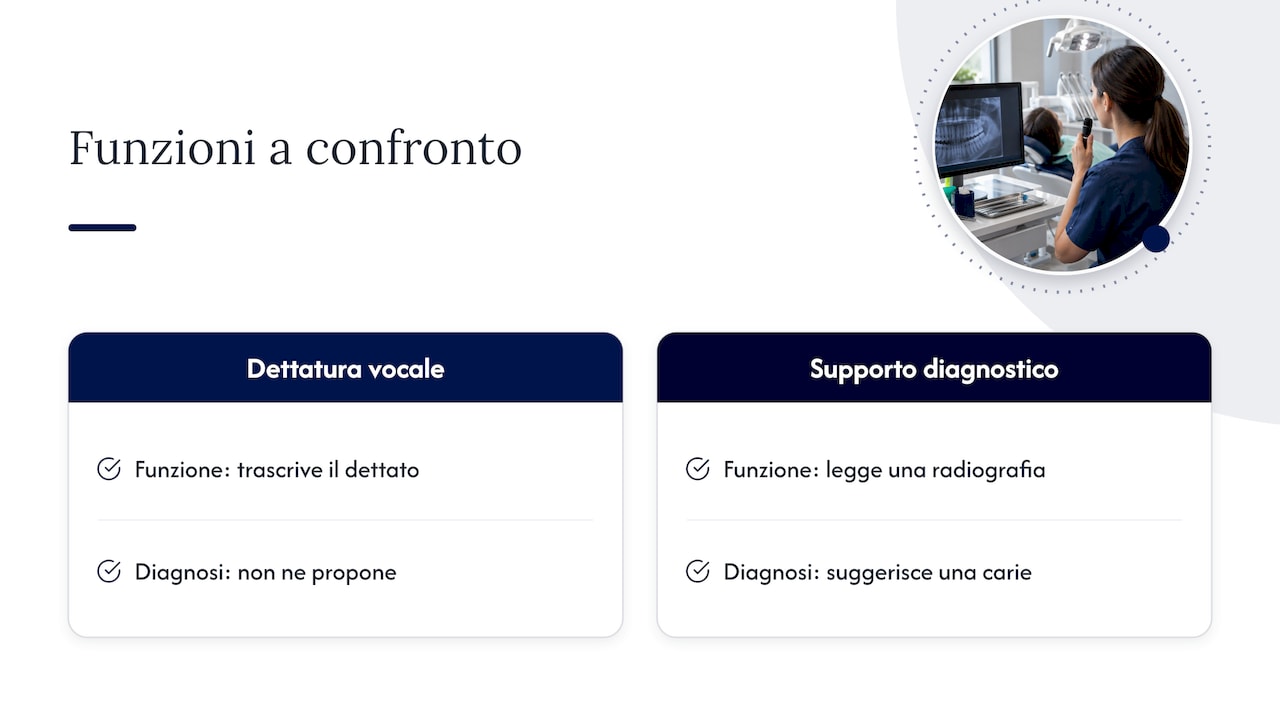
The AI Act imposes stricter obligations on high-risk systems, including those falling under medical device regulations or supporting diagnostic decisions. A tool that transcribes what the dentist dictates, without suggesting diagnoses, has a different profile than software that reads an X-ray and suggests a cavity. The exact classification depends on its actual function, however: ask the vendor how they have classified their system under Regulation 2024/1689 and have that interpretation confirmed by your consultant.
In any case, a principle applies on which both the Authority and the AI Act agree: human oversight. The Authority describes data protection as a pact of trust between doctor and patient to be built from the design stage. In practice, the dentist reviews and confirms what the AI has transcribed, and the responsibility for the chart remains theirs.
The practice to avoid: uploading reports to chatbots
In July 2025, the Authority described as alarming the practice of uploading medical reports to generative AI platforms to ask for interpretations. In practices, this happens more often than one thinks: an orthopantomogram pasted into a chatbot to “get help” with a report, a voice note dictated into a messaging app. This is patient data leaving your control. The secure alternative is having AI inside your practice management software, under a contract you are familiar with.
Ten questions to ask the vendor before signing
Use this list with any practice management software featuring voice capabilities, including ours. Responses must be requested in writing and reflected in the contract and data processing agreement.
When does the microphone listen? It must activate upon operator command, not remain constantly listening.
Is the audio stored? If so, for how long and why. The ideal approach is to retain the verified transcription, not the recordings.
Where is the data processed and stored? Ask for the server location country and the list of sub-processors.
Does patient data train AI models? The answer you want is no, written into the contract.
Can I delete everything? There must be a clear deletion and export procedure, including upon contract termination.
Are there role-based profiles? The hygienist, the receptionist, and the external associate should not see the same things.
Is there an access log? Who opened which chart, when, and what they modified.
Does the dentist confirm the transcription? Every dictation must be reviewable and editable before becoming part of the permanent record.
Do you provide materials for the DPIA? Data flow diagrams, security measures, incident management policies.
How do you handle consents and privacy notices? Digital signatures, archiving, and linking to the patient file.
If a vendor answers vaguely to more than two of these questions, stop and have your privacy consultant review the contract before proceeding.
Organizing the practice: five concrete steps
Having the right tool is not enough: how you use it matters. Here is a practical sequence for a practice introducing voice dictation.
Map where speaking occurs. Operatories yes; reception and waiting areas no. The Authority, in a decision of June 11, 2026 stemming from on-site inspections, reiterated that audio recordings in workplace settings must be justified by purpose: audio capture must be limited to the locations and times where it is truly needed.
Update the privacy policy. Explain to patients that during the appointment the practitioner dictates the chart by voice, using which tool, for what purpose, and how long data is retained. The patient must be informed before sitting in the chair.
Define roles. Who can dictate, who can only read, who sees only the calendar and billing. Each person with their own credentials, never a shared account.
Train the team. A simple rule: dictate clinical data, not personal comments or third-party information. And no dictating while anyone who shouldn't hear is in the room.
Review and sign. At the end of the appointment, the practitioner reviews the transcription and confirms it. This is where human oversight happens.
A detail that patients notice: confidentiality also applies to human voices, not just machines. Calling patients by name and condition in the waiting room, or discussing an estimate out loud at reception, creates the same issues you are trying to avoid with software.
Switching practice management software: the opportunity to bring order to access controls
Many practices postpone moving to a cloud system for fear of migration. From a privacy perspective, however, staying on outdated software can be the greater risk: several legacy systems lack granular permissions and searchable audit logs.
The Authority demonstrated this with a concrete case. In the newsletter of September 25, 2025, it reported on a fine issued to a facility where all healthcare personnel could view the clinical history of any patient, regardless of their care pathway. It was a healthcare company, but the principle applies equally to a three-chair practice and a ten-location group: each person sees only the data of the patients they are treating.
During the migration, check three things:
Completeness: patient details, medical records, treatment plans, signed consents, and invoice history arrive intact.
Permissions: do not replicate the old configuration out of habit. Redesign profiles from scratch.
Decommissioning the old system: decide what remains archived, for how long, and who can access it, and document it.
For chains and multi-location groups, this topic is even more relevant: standardizing records and billing across locations also means having a single access policy, rather than many varying local rules.
Invoices and the Health Card System: privacy also involves administration
The confidentiality of health data also has implications for invoicing. The Italian Revenue Agency clarifies that for healthcare services provided to individuals, electronic invoices are not issued via the SdI, and the ban remains even if the patient objects to sending data to the Health Card System (Sistema Tessera Sanitaria). The same FAQs note that the invoice description must not include clinical details beyond what is required by law. Circular no. 14 of June 17, 2019 explains the rationale: these data are particularly sensitive and must be protected.
For the front desk, this means the software must automatically handle non-SdI invoices, submissions to the Health Card System, and any patient opt-outs, without manual steps that multiply errors. These rules can change with annual budget laws: verify every year with your accountant.
Our perspective
We built Treatbase based on a conviction: voice is the most natural way to fill out a chart, but only if the dentist remains in control of what is written. That is why dictation in Treatbase is not a generic assistant tacked onto the software. It is the hands-free way to complete the clinical record and periodontal charting, within the same system where you manage staff permissions, digitally signed consents, and archiving.
Every day we see practices wasting hours on transcription and paperwork, while at the same time being afraid to “put a microphone” in the room. These are two problems with a single solution: a clinical tool, with clear roles, where the practitioner reviews and confirms. Privacy must not become a reason to remain on an old system, because often an old system protects data worse than a modern, properly configured one.
We also acknowledge an inconvenient truth: no software makes a practice compliant on its own. Privacy policies, DPIAs, and team training remain the responsibility of the data controller. We can provide you with the tools and information to do them well, and answer the ten questions above without beating around the bush.
— Matteo
Treatbase for your practice
If you want to try voice-enabled records and voice-command periodontal charting, discover Treatbase dental practice management software: cloud-based, multilingual, with billing, automated patient reminders, digital consents, and role-based permissions for every team member. Data migration from your current software is included at no extra cost. Bring the checklist from this guide and put us to the test.
Frequently Asked Questions
Can I use Alexa or another smart speaker in the practice?
In the waiting room for music, with caution; for clinical data, no. These devices are designed for home use, listen while waiting for the wake word, and send data to the manufacturer under terms the practice cannot control. The medical record requires a clinical tool covered by a data processing agreement.
Is patient consent required to dictate records by voice?
Processing data for healthcare purposes already has a legal basis under the GDPR, so separate privacy consent is not required solely for dictation. However, a clear privacy notice is needed explaining the tool, purpose, and retention periods. For special cases, such as using data for research or other purposes, consult your DPO or privacy consultant.
Should the DPIA be carried out by the vendor or the practice?
The DPIA is the responsibility of the data controller, meaning the practice or the company that operates it. However, the vendor must provide you with the necessary technical information: data flows, security measures, sub-processors, and incident response procedures. If the practice has a DPO, they should be involved from the start.
Should audio recordings be stored together with the medical record?
Generally, no: what matters is the clinical record verified by the practitioner. Storing unnecessary audio conflicts with the principle of data minimization and increases risk in the event of an incident. If you decide to keep them for a specific reason, document it in the DPIA with retention periods and justifications.
What changes for chains and multi-location groups?
Scale changes: more operators, more locations, more access permissions to govern. It is best to define role-based profiles that apply across all locations, a single privacy notice, and a single record of processing activities, while choosing software that allows you to review logs from all locations in one centralized place.
Sources
Italian Data Protection Authority: Digital assistants, tips for privacy-proof use (PDF)
Italian Data Protection Authority: Provisions on the collection of information on HIV status
Regulation (EU) 2024/1689 on Artificial Intelligence, EUR-Lex
Italian Data Protection Authority: Speech by Agostino Ghiglia on AI and profiling
Italian Data Protection Authority: Data protection as a pact of trust
Italian Data Protection Authority: Statement on medical reports and generative AI, July 30, 2025
Italian Data Protection Authority: Provision of June 11, 2026
Italian Data Protection Authority: Newsletter of September 25, 2025 on electronic health records
Italian Revenue Agency: FAQs on invoices for healthcare services
Italian Revenue Agency: Circular no. 14 of June 17, 2019 (PDF)