Voice transcription in dentistry: a practical guide for the clinic
Discover how voice transcription in the dental practice reduces typing, streamlines workflows, and frees up time for patients, with review...

Voice transcription in dentistry: a practical guide for the practice
Voice transcription reduces the time spent filling out medical records and frees up valuable minutes for the patient, but it only works if the practice builds a serious review protocol around it. The advantage is tangible: less typing, more orderly workflows, less backlog at the end of the day. The non-negotiable condition is equally tangible: no transcribed text enters the record without professional verification, and audio recording must be managed in compliance with GDPR and compliant preservation regulations.
In brief:
Voice transcription in dentistry requires a structured protocol for review and data management in accordance with GDPR regulations to be effective and legal.
Transcription accuracy depends on audio quality and the use of customized clinical glossaries, not just ASR software.
Human review of the generated text is always essential, as clinically significant errors can occur without careful verification.
Direct integration with the practice management software allows texts to be automatically inserted into the correct sections of the medical record, reducing manual steps.
The most effective voice processing technology is achieved by first defining a role protocol and adopting appropriate audio quality tools.
TreatbaseFill out the chart with your voiceTreatbase uses voice artificial intelligence to simplify the daily management of the dental practice and reduce manual transcription.Discover Treatbase
Table of Contents
What is voice transcription in dentistry and when to use it
Practice activities that transcription can support
Protocol: what to define before recording
Audio acquisition: tools, formats, and minimum recommended quality
Review and quality control of transcription
Integration with medical records and management workflows
Privacy, GDPR, and compliant preservation for recordings and transcriptions
Practical implementation: a 5-step checklist for the practice
How Treatbase integrates voice AI into the daily work of the practice
Voice transcription is not a technical problem, it is a process problem
Why Treatbase is the natural step after manual transcription
Sources
Frequently Asked Questions
What is voice transcription in dentistry and when to use it
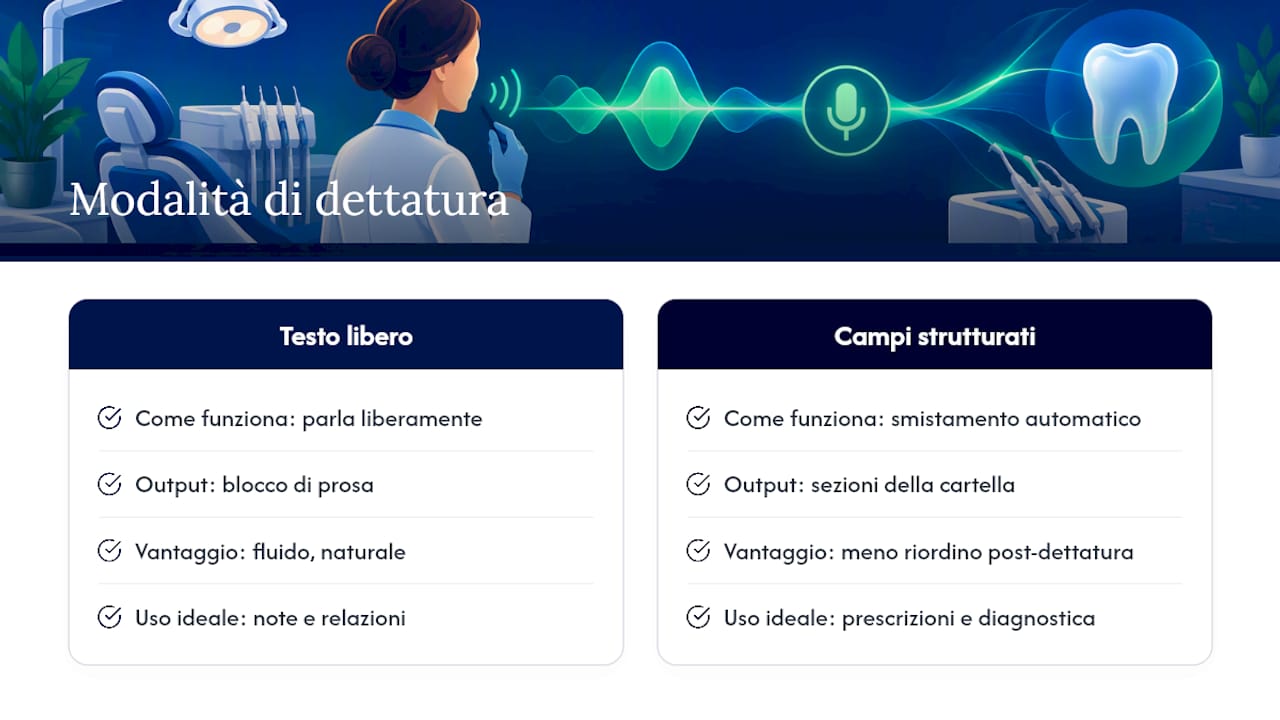
Voice transcription, technically based on Automatic Speech Recognition (ASR) systems, converts the clinician's voice into written text. There are two main modes: free-text dictation, where the professional speaks and the system returns a block of prose to be reviewed, and structured field dictation, where the spoken words are routed directly into the correct sections of the record (diagnosis, therapy, prescription). The second reduces subsequent reorganization work and is the focus of more recent dental management systems.
The most effective uses in the practice include clinical visit notes, operative reports, referral letters to specialist colleagues, and clinical or team meeting minutes.
An accepted manuscript published by King’s College London shows that pipelines combining ASR and language models for generative correction significantly reduce the Domain Word Error Rate compared to commercial ASR engines used alone, but also highlights clinically significant errors when the transcription is not reviewed. Dictation remains a powerful tool, not a substitute for clinical judgment.
Practice activities that transcription can support
Voice transcription is not limited to medical records: it can ease a major part of the practice's daily documentation burden.
Clinical annotations and operative reports. Dictating diagnosis, treatment plans, and post-intervention notes reduces downtime between patients.
Letters and professional communications. Reports for colleagues, orthodontists, or oral surgeons can be dictated immediately after the visit, while details are still fresh.
Administrative documents. Billing notes, internal reminders, and communications with patients can be dictated instead of typed, especially on high-volume days.
Internal training. Recording team briefings or instructions for new staff creates reusable material without the effort of manual transcription.
Every item on this list shares the same principle: dictation accelerates the first draft, but someone in the practice remains responsible for the final content.
Protocol: what to define before recording
Before pressing the record button, the practice should establish some basic rules in writing; otherwise, audio files accumulate without context and review becomes slower, not faster.
To be established in advance:
Purpose of the recording: clinical note, internal training, or meeting, because this changes who needs to review it and how it should be archived.
Person responsible for recording and review: almost always the same clinician who speaks, but in larger teams it is advisable to assign a second check.
Information notice and consent: when the recording involves patient data, a clear information notice on processing is required, as demanded by the Privacy Guarantor guidelines.
Minimum metadata: date, time, patient or topic, operator, so that each file remains traceable.
A tip: create a fixed voice template to pronounce at the start of the recording (“patient, date, reason for visit”): the system transcribes it as an automatic header and drastically reduces manual reorganization work later.
Audio acquisition: tools, formats, and minimum recommended quality
Transcription accuracy depends more on the quality of the incoming audio than on the chosen software. A poorly positioned cheap microphone produces more errors than a mediocre ASR system with a good signal.
Some practical guidelines for the practice:
Prefer a desktop condenser microphone or a headset with noise cancellation, rather than the computer's built-in microphone.
Record in WAV or FLAC format when possible, with at least a 16 kHz sampling rate: highly compressed formats degrade the recognition of clinical terms.
Name files using a fixed scheme (date, patient, operator) to avoid confusion between sessions.
Minimize background noise such as aspirators, running drills, or overlapping conversations, which are the most common cause of transcription errors.
Speak at a steady pace and articulate drug names and numbers clearly, where errors carry more weight.
Unclear pronunciation and ambient noise remain the two variables that degrade accuracy more than any other technical factor, even more than the microphone used.
Review and quality control of transcription
No transcription, no matter how accurate, should be copied into the patient record without checking. Legal responsibility for the content remains with the professional who signs the note, not the software that generated it.
An essential review checklist should verify:
Correct clinical terminology (tooth names, procedures, materials)
Dosages and drug names, where an error can have clinical consequences
Negations (“does not present” versus “presents”), often inverted by ASR systems
Numbers and dates, typically transliterated poorly from speech
A study published in a peer-reviewed journal reports a significantly low Domain Word Error Rate for an ASR pipeline corrected with language models, compared to much higher values for commercial ASR systems used without correction, with the margin of error increasing further in the presence of background noise. This is the difference between “usable with a quick review” and “having to rewrite almost from scratch.”
To reduce repeated errors, it is useful to build a customized clinical glossary with the terms most commonly used in the practice (drug names, materials, internal abbreviations). The adoption of glossaries and correction models reduces recurring errors and accelerates the review phase, according to the same King’s College London study cited above. In practice, the time invested in the first week to train the glossary quickly pays off in subsequent reviews.
Integration with medical records and management workflows
An isolated transcription, saved as a separate text file, is of little value. Real value is created when the text goes directly into the correct section of the electronic medical record, without manual copy-and-paste steps.
The most common integration methods are:
Direct APIs between the transcription engine and the management system, which write the text into the correct field in real-time.
Import and export of structured files, slower but useful when the two systems do not communicate natively.
Predefined field templates, where dictation recognizes keywords (“diagnosis”, “therapy”, “prescription”) and routes the text accordingly.
The difference between free notes and structured fields matters more than it seems: a block of free text requires someone to reread and manually reorganize it into the correct sections of the record, whereas a structured field workflow reduces this step, an area where modern visit management software focuses heavily. The ideal workflow starts with dictation, moves to clinical review, and concludes with compliant archiving in the practice's document storage system.
Privacy, GDPR, and compliant preservation for recordings and transcriptions
Audio recordings in healthcare process special categories of data according to the GDPR, so transparency and security rules are more stringent than for any ordinary administrative document.
Main obligations to comply with:
Clear information notice pursuant to Art. 13 GDPR on the purposes, methods, and preservation period of processing.
Detailed access logs to the health record, showing the date, time, and identity of whoever consulted or modified the file.
Specific consent when the recording concerns past data not collected directly for that purpose.
Differentiated access control between clinical and administrative staff.
The Privacy Guarantor has reiterated that the lack of an adequate information notice or detailed tracking of accesses to the health record can render the entire data processing unlawful, regardless of the technical quality of the transcription.
The provision of the Privacy Guarantor dated May 14, 2026, explicitly sets these requirements for health records. Regarding the legal validity of documents, the AGID guidelines on electronic documents establish that electronic copies or extracts have probative value only if accompanied by process certification, digital signature, or a certain time reference: without these elements, the archived transcription risks having no legal weight in the event of a dispute.
Practical implementation: a 5-step checklist for the practice
Introducing voice transcription works better as a gradual project rather than a sudden change of habits for the entire team.
Assess the actual need. Count how many hours per week the team spends typing notes and letters to understand where the return is greatest.
Write the internal protocol. Define the purpose, responsibilities, and information notice before recording the first word, as described in the dedicated section.
Test hardware and software on a small sample. A microphone and an ASR engine should be tested for two weeks before generalizing their use.
Conduct a pilot with a single clinician or a single location. Collect feedback on recurring errors and actual review times.
Formalize preservation and auditing. Establish who checks the access logs and how often they are verified.
How Treatbase integrates voice AI into the daily work of the practice
Treatbase was created specifically to eliminate the most fragile step in the workflow described above: the transition from dictation to the medical record. The system converts the clinician's voice directly into structured fields, including hands-free periodontal charting, without the need for intermediate manual transcription. According to the company, practices adopting this approach can save over 1,000 hours of administrative work per month, time that can be reinvested at the chairside or in patient care.
In addition to dictation, the management system covers automated billing, patient reminders, and practice performance monitoring, with free data migration from the previous system. Anyone wishing to understand how visit management works in practice can start with the dedicated documentation before requesting a demo.
Voice transcription is not a technical problem, it is a process problem
Public discussion about voice transcription in dentistry almost always focuses on the accuracy of the ASR engine, as if a better algorithm were enough to solve everything. This is a partial reading. Data from King’s College London show pipelines capable of drastically reducing domain errors, but the same study notes that without review, clinically relevant errors remain. The bottleneck is almost never the software: it is the absence of a protocol stating who reviews what, and when.
Many practices buy a dictation system and expect the time savings to come automatically. They do, but only after the team has broken in clinical glossaries, pronunciation habits, and a shared review checklist. The first two weeks are slower, not faster: those who expect otherwise abandon the tool too soon.
The priority, before choosing any product, is to write the internal protocol: who records, who reviews, how consent is documented. Technology comes after, not before.
— Matteo
Why Treatbase is the natural step after manual transcription
If the practice has already realized that dictation saves time, the logical next step is to remove manual transcription as a separate phase. Treatbase converts voice directly into medical record fields, including hands-free periodontal charting, without the intermediate step of listening to an audio recording and copying it over by hand.
Multi-user and multi-lingual management allows standardization of clinical records and billing even in practices with multiple locations, with integrated digital archiving and performance reports. Data migration from the previous management software is fast, without long operational interruptions. Those managing multiple collaborators can see in detail how permissions and performances work in the dedicated section for collaborators and services, a good starting point to see if the model fits your organization. For those who want to start immediately, the Treatbase dental management software page gathers all the information to request a personalized demo.
Sources
Frequently Asked Questions
How is a voice recording transcribed in dentistry?
A speech recognition (ASR) software is used to convert audio into text, ideally connected to the management system so that the text goes directly into the correct fields of the medical record. Transcription must always be reviewed by a professional before being considered final, verifying in particular clinical terms, dosages, and negations.
Are there free voice transcribers suitable for dental practices?
There are free generic dictation tools, but they are not designed for dental terminology, integration with medical records, or compliant preservation requirements. Dedicated software reduces correction work and directly connects dictation to the structured fields of the record.
Can ChatGPT transcribe an audio recording from the practice?
Some language models can process and correct a transcription already generated by an ASR engine, but they are not designed as primary clinical transcription tools, nor do they inherently comply with the preservation and privacy requirements demanded for medical records. For clinical use, a system designed for the dental field is required, with mandatory professional review.
How much time is really saved with voice transcription?
The savings depend on the volume of documentation in the practice and the level of integration with the management software. Pilot tests described in the King’s College London research indicate significant reductions in the time required to generate clinical summaries compared to manual typing, although these remain experimental data to be verified case by case.
How much does Treatbase cost?
Treatbase does not publish a fixed price on its website: costs are communicated upon request based on the practice's needs. Updated information is available on the official product page.