Post-treatment follow-up: what to do immediately and how to document it
Post-treatment follow-up with two-channel reminders and recorded consent reduces no-shows and ensures GDPR compliance.

Post-treatment follow-up: what to do right away and how to document it
Activate automated reminders across at least two channels and record the agreed recall interval along with consent to be contacted in the patient's file. Always ensure that sent messages do not contain sensitive clinical data, limiting them to date, time, and practice contact details. This approach reduces missed appointments and keeps the process GDPR-compliant.
In brief:
The dental team sets the interval on a case-by-case basis: up to 12 months for routine check-ups, less than 3 months only if clinically indicated.
The recommended sequence includes immediate confirmation, alerts at 7 days and 48 hours, then a message on the day itself; for complex cases, it is better to call.
Messages containing date, time, and location do not require separate consent for treatment purposes, but the practice must record consent for communications.
Automation is associated with an approximately 7 percentage point drop in no-shows; also monitor responses and the wait time between booking and the appointment.
If the patient does not show up and does not respond to reminders, follow up by phone within 24–48 hours and note the outcome in the medical record.
TreatbaseSimplifies patient recallsTreatbase includes automated patient reminders, alongside tools to manage invoices and monitor practice performance.Discover Treatbase
Table of Contents
Why post-treatment follow-up matters for your practice
When to schedule recalls: intervals and documentation
Operational workflow: channels, timing, and ready-to-use templates
Privacy and GDPR: how to send reminders safely
Metrics to monitor to evaluate follow-up
Practical checklist for implementing follow-up in the practice
A perspective on follow-up automation
How practice management software like Treatbase simplifies post-treatment follow-up
Frequently Asked Questions
Sources
Why post-treatment follow-up matters for your practice
Well-organized follow-up is not just an administrative task: it directly affects clinical outcomes and the practice's financial health. Recalling patients at the right time allows for early detection of complications, cavities, or periodontal issues, turning a routine check-up into a real opportunity for prevention.
From a management perspective, automated reminders have a measurable impact on appointment attendance. Using automated reminders is associated with an approximately 7 percentage point reduction in the no-show rate—a margin that translates to more occupied dental chairs each week for a practice with a full schedule.
There is also a relationship component that is often underestimated:
a patient who receives a clear reminder perceives care and organization from the practice
consistency in recalls builds trust and reduces treatment dropout
timely communication decreases last-minute recovery calls, easing the front desk's workload
Follow-up, therefore, is both a clinical tool and a patient retention tool.
When to schedule recalls: intervals and documentation
Choosing the recall interval should neither be left to chance nor applied identically to all patients. Oral health guidelines indicate that the decision on the interval must be made by the dental team on a case-by-case basis, recorded in the chart, and reviewed at each visit, as stated in the oral health review recommendations.
In practice, this means following a few operational criteria:
for routine check-ups, the recommended interval is up to 12 months for most patients
a recall under 3 months should be reserved for clinically indicated cases, not applied as standard practice
the chosen interval and the patient's agreement must be noted in the clinical chart at the end of the visit
at each subsequent check-up, the interval should be reassessed and, if necessary, updated in the scheduling plan
This discipline prevents two opposite mistakes: recalling low-risk patients too frequently, cluttering the schedule without clinical benefit, or losing track of patients who actually need more frequent check-ups. Documenting the decision, in addition to being good clinical practice, protects the practice in the event of disputes regarding continuity of care.
Operational workflow: channels, timing, and ready-to-use templates
A well-timed sequence of contacts reduces the burden on the front desk and increases the likelihood that the patient shows up. Here is a structure that works for most practices:
Booking confirmation: an immediate message summarizing the date, time, and location of the appointment.
7-day reminder: a recall via SMS or practice management software notifications, useful for catching potential scheduling conflicts in time.
48-hour reminder: the point when most avoidable cancellations are managed, offering the chance to reschedule without losing the slot.
Same-day reminder: a final, short, and direct notice that reduces the risk of last-minute forgetfulness.
For complex cases, such as surgical procedures or patients with sensitive medical histories, a phone call remains the best channel: it allows you to verify understanding of instructions and answer questions in real time. SMS and email, on the other hand, are well-suited for operational reminders, provided they remain free of sensitive clinical information. A handy SMS template is: "Reminder: you have an appointment on [date] at [time] at our practice. To reschedule, reply to this message or call us." For email, simply expand the same layout with the address and direct contact details.
It is also worth segmenting patients based on history: those who have missed appointments in the past benefit from a higher reminder frequency, perhaps with an additional message at 72 hours. For practical ideas on how to structure reminder timing, it can be helpful to consult dedicated resources such as this guide on techniques to avoid missed appointments, designed for those managing busy schedules.
A quick tip: keep reminder texts short and consistent in structure: patients recognize the format and read it faster.
Privacy and GDPR: how to send reminders safely
Operational reminders—those communicating only the date, time, and location of the appointment—are generally lawful because they fall under processing necessary for the provision of care and do not require separate consent as marketing communications do. The critical point is the channel: using unsecured messaging apps to exchange health information poses real risks, as highlighted in guidelines on the risks of texting patients via unsecured channels.
To stay compliant, it is best to follow a few practical precautions:
update the privacy policy, clearly stating the purposes of reminders and the channels used
track communication consent in the patient's record, distinguishing it from any marketing consent
avoid including diagnoses, treatments, or other health data in the text of the messages
prefer integrated, encrypted practice management solutions over generic messaging tools
maintain a log of sent communications with a defined retention policy
The Privacy Authority's guidelines on data processing for healthcare purposes highlight the sensitivity of health data and the need for clear privacy notices. For practice managers, the GDPR guide dedicated to medical practices also offers operational guidance on roles and duties to assign to front desk staff.
Metrics to monitor to evaluate follow-up
Without numbers to look at, it is difficult to know if the follow-up process is truly working. Three indicators deserve a permanent spot on a practice dashboard: the no-show rate before and after introducing automated reminders, the reminder response rate (how many patients confirm or reschedule), and the average time elapsed between booking and the appointment.
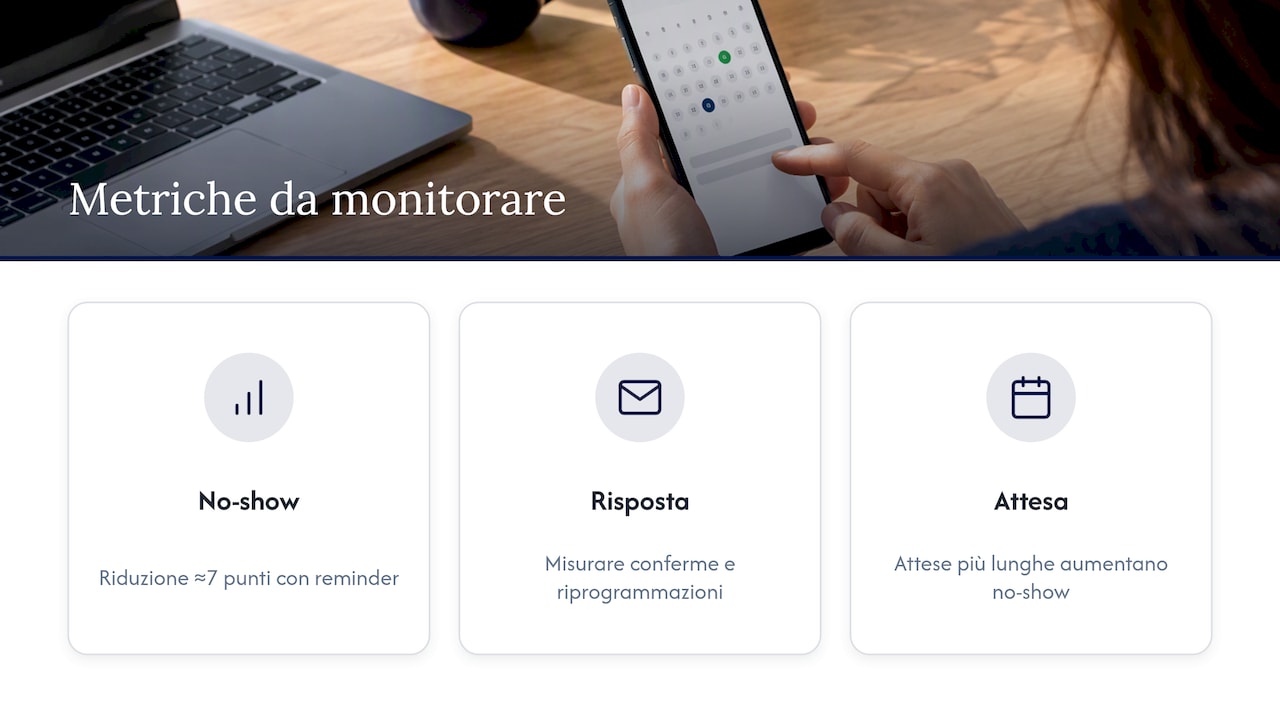
Automating reminders reduces the no-show rate by approximately 7 percentage points, a figure that demonstrates a concrete return on investment for structured reminders. Longer wait times between booking and the visit tend to increase the risk of no-shows, so it is worth monitoring this interval as a predictive indicator as well.
Once this data is collected, segmentation helps target interventions where needed: testing variations in messaging or timing only on higher-risk patients, rather than modifying the entire workflow, allows you to measure the impact without disturbing those who already attend regularly.
Practical checklist for implementing follow-up in the practice
Getting it up and running requires just a few steps, but they must be followed in order:
Map the current process: identify where patients are being lost between booking, reminders, and actual attendance.
Configure templates and timing in the software, simultaneously updating the privacy policy.
Train the front desk staff on the new workflows, including exceptions to handle manually.
Test for 2–4 weeks on a subset of patients before rolling out the process across the entire schedule.
Monitor KPIs and adjust channels, copy, or frequency based on observed results.
For cases of non-response, such as a patient who does not reply to any reminders, it is best to schedule a telephone follow-up within 24–48 hours of the missed appointment, noting the outcome in the record to decide on next steps.
A perspective on follow-up automation
Automating reminders does not replace clinical judgment; it frees it from repetitive tasks. The real risk is not relying on an automated system, but using it without oversight: a reminder sent at the wrong time or with the wrong content is worse than no reminder at all. Solutions that integrate traceability and compliance into the same workflow, rather than adding them as a separate step, are the ones that truly save time for front desk staff.
— Matteo
How practice management software like Treatbase simplifies post-treatment follow-up
Managing reminders, consents, and KPIs across separate tools is the fastest way to lose track of details, especially as the practice grows. We work with cloud-based management software that centralizes these steps in a single environment, designed for dental practices that want to stop chasing notes scattered across calendars, charts, and spreadsheets.
Automated reminders are set up once in the calendar and repeat according to the chosen sequence, while each recall interval remains recorded in the patient chart alongside the recorded consent. Integrated reports display the no-show rate and recall compliance without needing to export data elsewhere, and migration from existing systems is free, so the transition won't lock up your schedule for weeks. Those who want to see how schedule and new patient management works can request a demo at Treatbase.
Frequently Asked Questions
How often should follow-up occur after dental treatment?
For routine check-ups, the recommended interval is up to 12 months, while more frequent recalls—under 3 months—only apply when clinically necessary. The decision must be made case by case by the dental team and recorded in the patient chart.
Do automated reminders really reduce no-shows?
Yes, using automated reminders is associated with an approximately 7 percentage point reduction in the no-show rate. The effect is more pronounced when reminders follow a timed sequence rather than a single, isolated message.
Is it legal to send reminders to patients via SMS or email?
Yes, if the message only concerns the date, time, and location of the appointment and contains no sensitive clinical data, it falls under processing for care purposes. However, it is preferable to avoid unsecured messaging apps, as highlighted in guidelines regarding the risks of unsecured messaging.
What should a good follow-up message contain?
It should clearly state the date, time, and location of the appointment, as well as a simple way to confirm or reschedule. Post-operative instructions or clinical information should be communicated by phone or during the visit, not via SMS.
What should you do when a patient does not reply to any reminders?
It is advisable to arrange a telephone follow-up within 24–48 hours of the missed appointment, noting the outcome in the chart. This makes it possible to distinguish an occasional mishap from a pattern of disengagement that requires a different approach.