Multi-site dental management software: what is really needed
Discover how a multi-clinic dental management software with synchronization, a shared calendar, and records protects privacy and facilitates migration.

Multi-site dental practice management software: what is really needed
To coordinate clinical records and administration across multiple locations, a centralized cloud management software is required, featuring real-time synchronization and a standardized clinical record system across all branches. Solutions address these needs with features like voice dictation, data migration, and dedicated tutorials. In the following sections, we will examine data, scheduling, consent, privacy, and migration: the five areas where a dental group faces the greatest risks.
In brief:
It is essential to verify that the cloud management software guarantees real-time synchronization and reliable backups in the event of a network outage.
Data migration must be planned with pilot tests and rollback strategies, involving specific training for each role.
Compliance with privacy guidelines and impact assessments are mandatory, especially for artificial intelligence systems processing health data.
The shared and standardized clinical record must include controlled versions and differentiated permissions to avoid inconsistencies between sites.
A practical demonstration of the software, including actual migration and synchronization, is crucially important to evaluate its effectiveness in a multi-site context.
TreatbaseCoordinate your dental practices betterTreatbase centralizes clinic management, from clinical records to invoicing, with voice tools and automated reminders.Discover Treatbase
Table of Contents
Essential features for multi-site dental practice management software
How to choose, test, and deploy software across multiple locations
Privacy, paperless consent, and the limits of artificial intelligence
How practice management software can meet multi-site requirements
Multi-site rollout: what works and where mistakes are most common
Next steps with Treatbase: demo, migration, and tutorials
Documents and guidelines cited
Sources
Frequently Asked Questions
Essential features for multi-site dental practice management software
A group with multiple clinics thrives on daily coordination among receptionists, hygienists, and dentists who often work across different locations in the same week. The software must manage this complexity without creating duplicates or parallel versions of the same information.
The shared calendar is the first test: when two locations view the same calendar in real time, double bookings are reduced, and priority rules (for example, clinical emergencies before routine check-ups) are automatically applied, not just on paper.
A single clinical record, standardized across all locations, prevents a patient from having two different clinical histories depending on where they presented. This requires clear version control and differentiated role permissions, so that a hygienist cannot modify a treatment plan that belongs to the dentist.
The features that make a real difference in a multi-site context are:
Shared calendar with instantaneous synchronization across all locations within the group.
Single clinical record with version control and differentiated role-based permissions.
Centralized invoicing with separate reporting per location and consolidated reporting for the group.
Automations for reminders, periodic recalls, and multi-channel patient communications.
Dashboards with key indicators: average appointment times, operator productivity, and no-show rates.
Without a dashboard comparing different locations, an owner discovers productivity issues months late, when costs have already accumulated.
How to choose, test, and deploy software across multiple locations
Selecting multi-site software should be treated as a small project, using measurable criteria rather than just impressions gathered during a sales demo.
On a technical level, the first question concerns the architecture: a cloud-based system guarantees access from any location without local servers to maintain, but you must verify what happens when the connection drops, what service levels are guaranteed, and how clinical data backups are managed.
Here is an operational five-step checklist:
Verify technical requirements: cloud delivery, service level agreements, backup frequency, and behavior during offline access.
Define roles, permissions, and access logs, clearly distinguishing the business owner from the data controller.
Plan the migration: exporting existing data, mapping fields, pilot testing at a single location, and setting up a rollback plan in case of issues.
Organize training for receptionists, hygienists, and dentists with separate role-specific sessions, rather than a single generic course.
Measure results after 90 days: reduction in administrative time, number of invoicing errors, and average time to open a patient file.
A tip: have the pilot location work in parallel on both the old and new systems for two to four weeks before turning off the previous software: this drastically reduces the risk of data loss during the transition.
Privacy, paperless consent, and the limits of artificial intelligence
Multi-site management software processes health data, which means technical choices are both operational and regulatory. The AGID guidelines on the digitalization of informed consent clarify that electronic signatures must be designed alongside organizational processes for patient identification and document storage, rather than as an isolated technical feature.
On the vendor side, the Privacy Authority's Code of Conduct for management software defines roles and technical measures for those developing and distributing these systems, including migration and remote assistance activities.
The Privacy Authority considers certain artificial intelligence systems that process health data to be high-risk, as indicated in the ten rules on AI in healthcare: this means a data protection impact assessment may become necessary before activating voice-activated AI features on clinical data under certain circumstances.
In practice, ask the vendor for:
Encryption of data at rest and TLS protocol for data in transit.
Consultable access logs for every user and every location.
Compliant preservation methods for digital documents.
Documented procedures for any required impact assessments on AI systems.
How practice management software can meet multi-site requirements
Some software builds clinical records directly from the dentist's voice, eliminating manual transcription which often leads to discrepancies between locations. In some cases, the migration of existing data is offered at no extra cost, a factor that reduces friction when a group decides to change its software with multiple locations to coordinate in parallel.
To assist with practical evaluation, the following guides show how the system actually works:
Part I: clinic data, useful for understanding how multi-site settings are configured.
Part III: calendar and new patient, which demonstrates appointment synchronization between locations.
Part V: patients, dedicated to clinical workflows and the shared medical record.
Part VI: payments, for invoicing and reconciling payments received.
During a sales demo, always ask to see a real partial migration, calendar synchronization between two simulated locations, and an electronic signature test on an informed consent form: these are the three tests that reveal whether the system truly works in a multi-site context or only in theory.
Multi-site rollout: what works and where mistakes are most common
The most useful lesson from these projects is simple: a well-conducted pilot test combined with focused training drastically reduces operational disruptions compared to a simultaneous launch across all locations. Those who skip this phase pay the price in billing errors and incomplete patient files during the first two months.
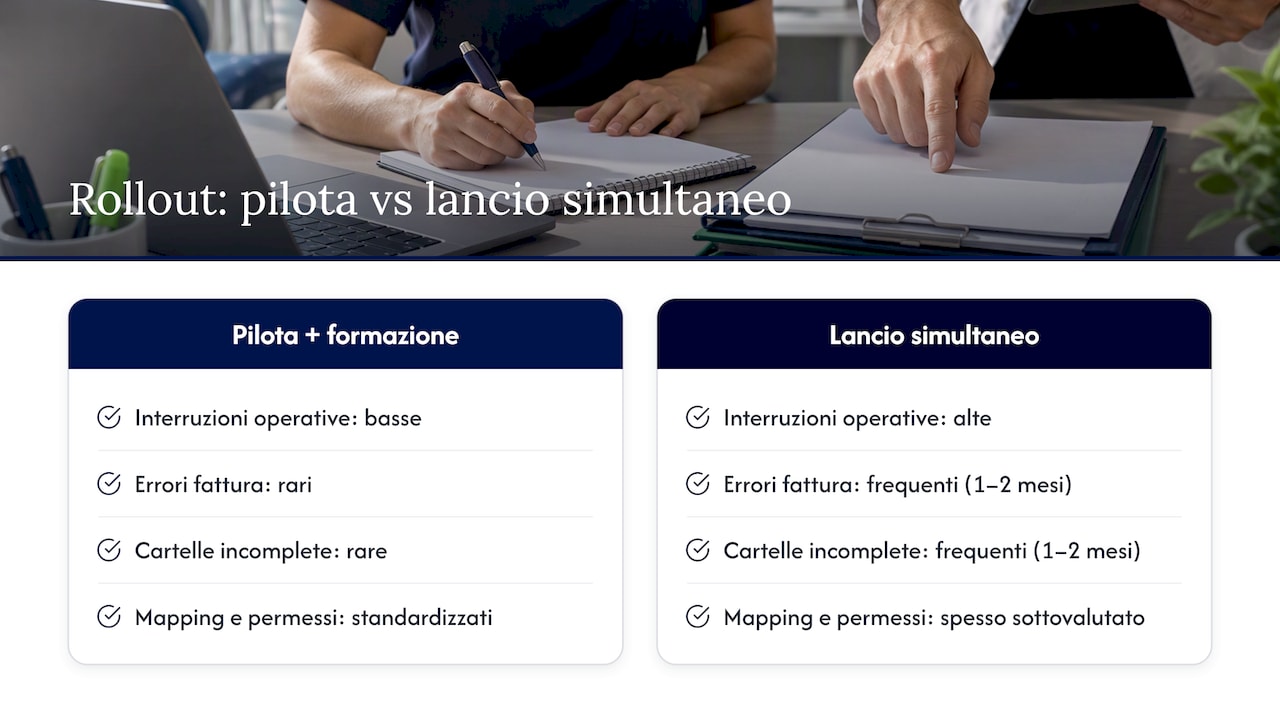
The most common mistake is not technical, but organizational: underestimating existing data mapping and the definition of role-based permissions. An owner who simply copies the structure of the old clinical chart without standardizing it first ends up reworking the same data twice. It is important to consider the impact assessment for systems that process health data using artificial intelligence, which is required by regulations in certain cases.
A practical suggestion is to build a verification checklist immediately after going live, with weekly checks during the first month, and then measure the same indicators every quarter: average chart opening time, billing errors, and no-show rates.
— Matteo
Next steps with Treatbase: demo, migration, and tutorials
For a multi-site group, a key advantage is avoiding manual transcription of clinical notes using voice-activated artificial intelligence; in some cases, the migration of existing data is done at no additional cost even when there are multiple locations to connect.
Before making a decision, bring three specific requests to the demo: a test migration with a real sample of patients, a simulated calendar synchronization between two locations, and an electronic signature test on an informed consent form. These three elements will show whether the system can truly handle the operational load of a multi-site group.
To orient yourself even before speaking with a sales representative, you can consult:
The page dedicated to the management software featuring a feature overview.
The tutorial on calendar and new patient to understand synchronization between locations.
The guide on payments to see centralized invoicing in action.
Anyone wishing to request a demo or begin their evaluation can start from the Treatbase main page.
Documents and guidelines cited
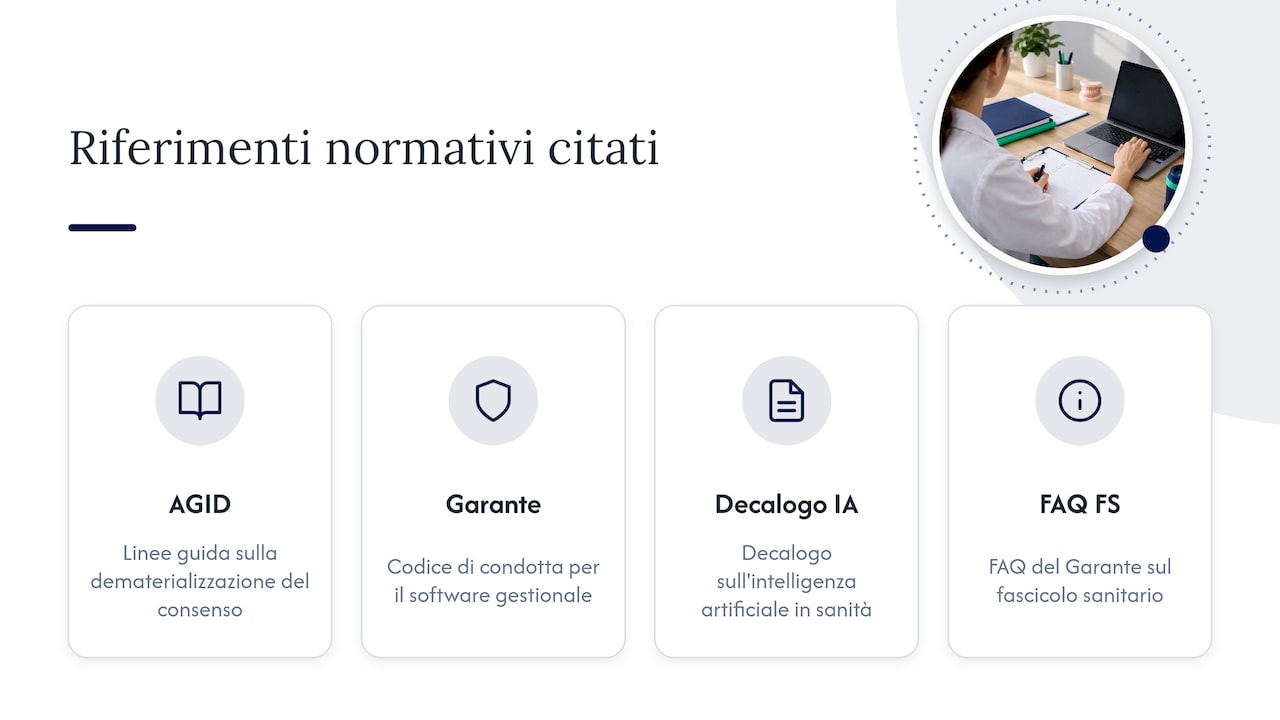
The regulatory sources cited in this article include the AGID guidelines on the digitalization of consent, the Privacy Authority's Code of Conduct for management software, the ten rules on artificial intelligence in healthcare, and the Authority's FAQs on health records. These are useful references to verify the compliance of any software before adopting it.
Sources
Frequently Asked Questions
What is the best management software for a multi-site dental practice?
There is no universally "best" software: the choice depends on how well the system guarantees real-time synchronization between locations, standardized clinical records, and secure data migration. Treatbase addresses these points with voice dictation for charts and migration at no additional cost, which are useful elements to verify during a live demo.
Are there free management systems suitable for a group with multiple locations?
Free solutions exist but they tend to limit critical features for multi-site setups, such as advanced shared calendars or consolidated reporting across locations. For a group with multiple clinics, a paid subscription with dedicated support reduces the risk of having to change systems after just a few months.
How do you standardize clinical records across different locations?
You begin by defining a single structure of fields and administrative protocols shared by all locations, even before migrating historical data. Only after this phase do you proceed with the import, avoiding duplicates and double-work on the same patients.
When is an impact assessment needed for software using artificial intelligence?
The Privacy Authority's ten rules on AI in healthcare state that AI systems processing health data are considered high-risk. In these cases, a data protection impact assessment becomes a step to verify with your privacy officer before activation.
Is the electronic health record linked to the practice management software?
The electronic health record is an interoperable ecosystem that collects clinical data from public and private facilities, as explained in the Privacy Authority's FAQs. Multi-site software should therefore consider its interoperability with this system, even when the connection is not yet mandatory for all facilities.