Management selection for DSOs: how to choose the right software
For a DSO, choosing management software means opting for multi-site cloud with EU residency, synchronization, and portability; find out how to evaluate it.

Management Software Selection for DSOs: How to Choose the Right Software
For a DSO, the right choice is a multi-site cloud management software that guarantees data residency within the European Union, cross-office synchronization, and complete data portability. Dealing with a management software that meets these three criteria using voice artificial intelligence, free data migration, and centralized billing is a recommended choice. Data security, integration between offices, and freedom from the vendor remain the three decisive criteria against which any proposal should be measured.
In brief:
Management software for DSOs must guarantee data residency in the European Union, cross-office synchronization, and complete data portability without the need to manually retrieve information.
It is essential to verify that the software has a shared medical record, an integrated calendar across multiple sites, and granular access controls, as well as supporting essential integrations like payments and digital signatures.
Compliance with GDPR regulations requires data to be hosted in environments with certifications such as ISO 27001 and that security measures like encryption and multi-factor authentication are adopted, taking cross-border transfers into account.
Data migration must be carefully planned, including historical consents and complete medical records, with tests on pilot sites and portability clauses to avoid vendor lock-in.
Before signing, it is essential to request certificates, recent audit reports, details on data transfer, and support response times from the vendor to ensure security and compliance with regulations.
TreatbaseSimplifies multi-site managementTreatbase brings medical records, billing, treatments, and reminders together in a single software for dental practices and multi-site groups.Discover Treatbase
Table of Contents
Practical criteria for evaluating management software for DSOs
Legal and data protection requirements for healthcare management software
Cloud architecture, security, and certifications to verify
Data migration and multi-site rollout: how to avoid common mistakes
Decision checklist: questions to ask the vendor before signing
Author perspective: practical lessons from the field
Why consider Treatbase as an option for your DSO
Sources
Frequently Asked Questions
Practical criteria for evaluating management software for DSOs
A DSO manages multiple sites with different teams who must work to the same clinical and administrative standards. The chosen management software must handle this load without creating bottlenecks between one location and another.
Points to check before signing any contract:
Shared medical record: accessible from all sites, with hands-free periodontal charting to speed up visits without interrupting clinical workflow.
Cross-office calendar: appointments manageable across different locations, centralized billing, and consolidated financial reporting for the entire group.
Roles and permissions: granular access control, so an office manager at one location cannot see clinical data unrelated to their role.
Essential integrations: payment systems, digital signature for consents, and accounting software already in use in the practice.
Scalability and support: clear SLAs and multilingual support if the group operates in different linguistic contexts.
Centralized billing deserves special attention: many management software systems designed for single practices handle revenue consolidation across sites poorly, forcing administration to export data and reconstruct totals manually. Verify during the demo whether the group financial report is native or has to be assembled manually.
A tip: always ask for a demo using real data from multiple sites, not the vendor's standard demo environment: synchronization issues only emerge with realistic volumes.

Legal and data protection requirements for healthcare management software
The Italian Data Protection Authority requires appropriate technical and organizational measures, data residency within the European Union, and granular consent management, including digital signatures for treatment forms.
Before choosing a vendor, check:
Where the data is physically hosted and if there are transfers to third countries.
Which legal basis the vendor applies for processing and how they collect informed consent.
Whether a Data Protection Impact Assessment (DPIA) is needed for the volume and sensitivity of the data processed.
Which certifications and audit reports the vendor can show upon request.
How encryption, multi-factor authentication, backup, and access logs are implemented.
The EDPB recommends DPIAs and additional safeguards when processing health data, highlighting the complexity of legal bases in transnational contexts according to the EDPB response on processing health data for research. For a DSO with multiple sites, often in different jurisdictions, this means including the DPIA in the selection process itself, rather than as a step after signing the contract.
Cloud architecture, security, and certifications to verify
The underlying technical architecture determines how much control you have over your data. A generic hyperscaler offers scalability but shares infrastructure with thousands of other customers; a regional cloud specialized in healthcare or a dedicated instance guarantees greater data isolation, often at the cost of lower flexibility.
Before signing, verify these points in order:
Which sub-processors the vendor uses and whether you have a contractual right to audit them.
What disaster recovery plan exists and which SLAs cover recovery times.
How connectivity is managed in locations with less reliable network infrastructure.
Which independent audit reports (SOC, ISAE 3402) the vendor can provide.
Which certifications they hold, particularly ISO 27001, ISO 27017 and, if relevant to the market, NEN 7510.
The HealthyCloud D2.1 deliverable indicates that cloud providers for health data must demonstrate high security standards and that those using them must carefully evaluate transfers to third countries, resorting to supplementary measures when necessary.
A tip: include an explicit request for copies of the most recent certificates and audit reports in the RFP, not just their mention in marketing materials.
Data migration and multi-site rollout: how to avoid common mistakes
Migration is the moment where most DSO projects run into difficulty. Data scattered across different management software, incompatible formats, and historical consents to reconstruct create delays if not planned in advance.
Before migrating, map out precisely:
Informed consents and signatures collected, including historical paper-based ones.
Complete medical records, including treatment history.
Payment data and accounting status of each patient.
For the rollout, follow a precise order:
Choose a high-volume site as a pilot, not the smallest or most marginal one.
Test cross-office workflows, such as booking an appointment at a location different from the patient's origin site.
Define measurable success criteria before extending the management software to other locations.
Train staff with dedicated sessions and monitor adoption, handling times, and errors in the first few weeks.
Always ask for contractual clauses that guarantee data portability in standard, readable formats to avoid being locked into a vendor that no longer works for the group.
Checklist decisionale: domande da porre al fornitore prima di firmare
Before signing, bring a list of concrete questions to every demo instead of just listening to the vendor's presentation.
Where does the data reside and what guarantees exist regarding transfers outside the EU.
Who has conducted or will conduct the DPIA and with what timeline.
What are the SLAs on backups, recovery, and support response times.
How does data migration work and how long does it take on average for one site.
What penalties or exit clauses apply in case of contract termination.
Area | Key question | Why it matters |
|---|---|---|
Compliance | Where does the data reside? | Determines exposure to transfers outside the EU |
Security | What certifications does it hold? | Independent proof of technical measures |
Operations | How long does migration take? | Impacts service downtime |
Contract | How do you exit the contract? | Prevents permanent vendor lock-in |
Author perspective: practical lessons from the field
DSOs that struggle the most with a new management software are those that skip the pilot and go straight to rollout across all locations. Cross-office workflows that seem obvious in a demo, like moving a patient between two locations, are often the first real breaking point. Measure, correct, then extend.
— Matteo
Why consider Treatbase as an option for your DSO
Among multi-site cloud solutions, software with voice artificial intelligence can eliminate manual transcription of medical records and reduce time spent on documentation. Free data migration managed by the vendor is an advantage when a group needs to consolidate records and consents from multiple sites without stopping clinical activity.
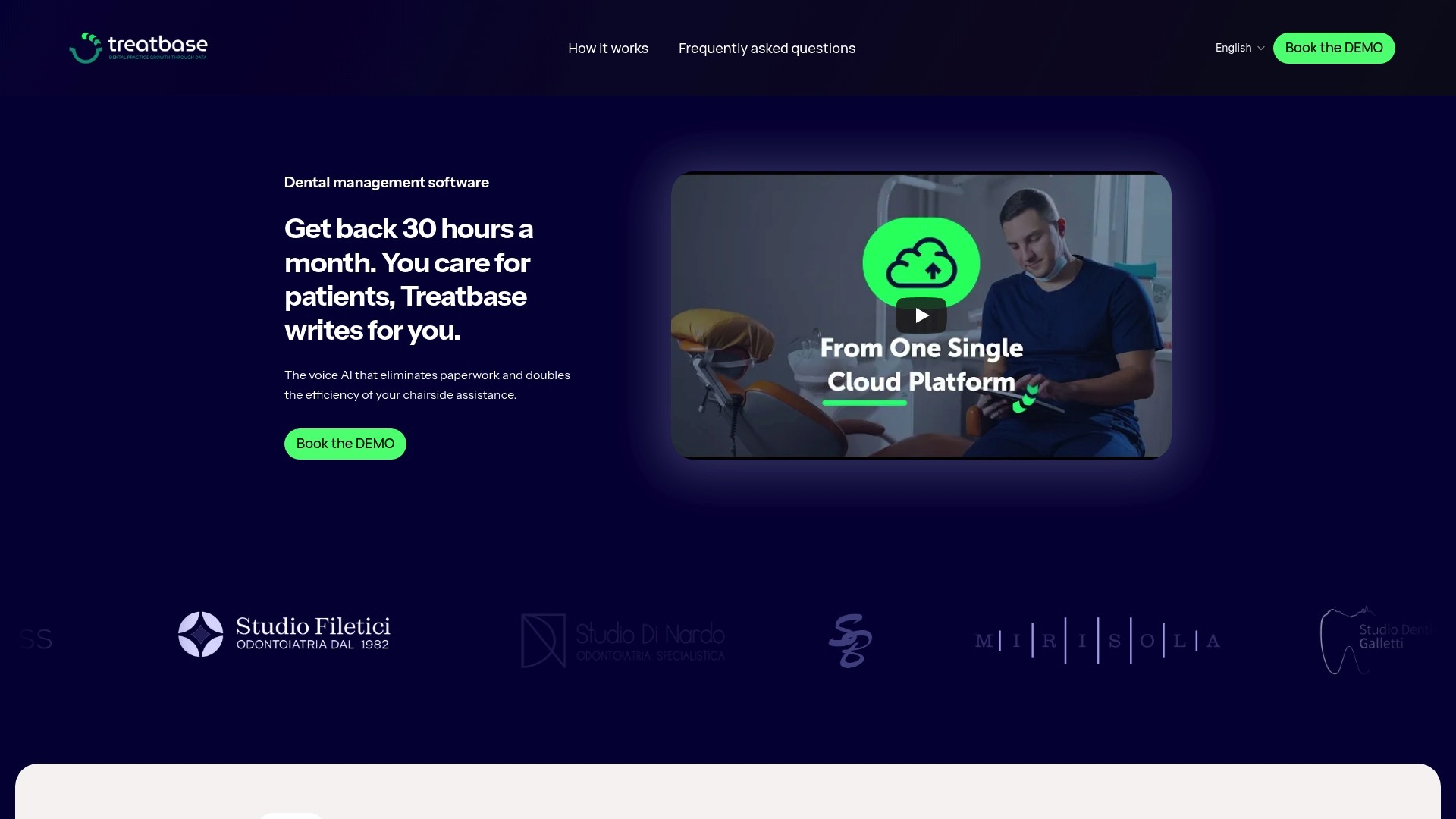
In addition to the clinical side, Treatbase offers automated billing, payment management, and digital archiving of consents—useful features precisely where traditional management systems require more manual work across different sites.
Hands-free periodontal charting integrated into the clinical workflow.
Data migration at no additional cost when switching from another management software.
Multi-user and multilingual management designed for groups with multiple locations.
If you are considering a pilot for your group, you can request a demo of the platform and directly verify the cross-office workflows described in this guide.
This article provides general information and does not replace the advice of a qualified healthcare professional. Consult a qualified healthcare professional regarding your specific case before taking action based on this content.
Sources
Italian Data Protection Authority — Guidelines on the processing of health data
EDPB — Response on health data processing for research and safeguards
HealthyCloud — D2.1: Cloud safeguards and GDPR considerations for health data
Frequently Asked Questions
What should a management software for DSOs have as a priority?
A management software for DSOs must guarantee data residency in the European Union, appointment synchronization across offices, and complete data portability in case of a provider change. Without these three elements, the risk of information silos between sites and vendor lock-in increases significantly.
Is a DPIA always required for cloud dental management software?
It is not always mandatory, but the EDPB recommends an impact assessment when processing health data on a large scale, as typically occurs in a multi-site DSO. The DPIA should be integrated into the vendor selection process, not added after signing the contract.
How long does a pilot last before full rollout?
There is no fixed duration valid for all contexts: the choice depends on the volume of the pilot site and the complexity of the cross-office workflows to be tested. However, it is recommended practice to conclude the pilot only after verifying measurable success criteria regarding adoption and operational errors.
How does data migration work with Treatbase?
Treatbase offers a free data migration managed directly by the vendor, designed to transfer medical records, consents, and administrative data from previous management software. The process covers the typical needs of a multi-site transition described in this guide.
What certifications should I ask for from a healthcare management software vendor?
The most relevant certifications to request are ISO 27001, ISO 27017 and, where applicable to the vendor's market, NEN 7510, along with independent audit reports like SOC or ISAE 3402. These independent proofs are a concrete way to verify the security measures claimed by the vendor.