Dental management software pricing: how much it costs in Italy in 2026
Calculate how much your clinic will pay for practice management software in 2026: a comparison of SaaS, per-chair pricing, and a practical guide to estimating the cost.

Dental practice management software pricing: how much it costs in Italy in 2026
In Italy, for most dental practices, the monthly cost of a SaaS management software starts from a few dozen euros up to an average cost per chair typical of vertical software, while enterprise or custom solutions require personalized quotes and more consistent initial investments. For almost all practices, a vertical management software on subscription remains the most sensible choice: it automatically updates compliance functions and reduces the operational load compared to rigid solutions. In the following paragraphs, you will find the method to calculate a realistic estimate and the right questions to ask providers.
In brief:
Monthly costs for dental practices vary from a few dozen euros up to around 100 euros, depending on the configuration level of the chosen SaaS management software.
For an accurate comparison between solutions, it is essential to calculate the total cost of ownership over five years, including setup, migration, and optional modules.
The choice between SaaS and custom solutions depends on the volume of activity: SaaS remains more cost-effective for practices with fewer than five chairs, while personalized options target multi-site groups with specific needs.
It is crucial to request a written quote that clearly separates the costs of fee, setup, training, and integrations to avoid future surprises.
Verifying that the management software supports regulatory compliance requirements, such as reporting to the Tessera Sanitaria System and appointing the provider as Data Processor, reduces legal risks and hidden costs.
TreatbaseReduce practice operational costsTreatbase simplifies dental management with voice dictation, invoices, treatments, and automatic patient reminders.Discover Treatbase
Table of Contents
Pricing models: SaaS, per-chair fee, and custom solutions
Cost components to include in every quote
Practical calculation of 5-year TCO
Practical checklist for choosing the right plan
Hidden costs and regulatory constraints affecting pricing
How Treatbase reduces operational costs and risks
Author's perspective: practical guidance for decision-makers today
Recommended option: how to try Treatbase and get a targeted quote
Sources
Frequently Asked Questions
Pricing models: SaaS, per-chair fee, and custom solutions
When discussing dental management software pricing, the first distinction concerns the business model. Software as a Service (SaaS) operates on a monthly or annual subscription: the practice pays a recurring fee, and the provider takes care of hosting, updates, and data security. It is the dominant model in the Italian dental sector because it distributes the cost over time and includes regulatory updates without additional intervention from the practice.
The SaaS fee is calculated in different ways depending on the provider:
per active chair, with pricing growing in proportion to the number of operational units
per user or workstation, useful for practices with many collaborators but few chairs
as a fixed package with optional modules that can be activated separately
Public price lists for Italian vertical dental management software typically start from a few dozen euros per month for basic plans and reach around 100 euros per month for more complete configurations, according to market analysis by Ivemind. Multi-site practices or dental chains may exceed this range when adding advanced reporting modules or multiple integrations.
A custom solution (dedicated development or deep customization of an existing platform) only makes sense when the practice has very specific needs: management of non-standard clinical protocols, integration with existing corporate management systems in multi-site groups, or data volumes requiring dedicated infrastructure. In these cases, the price is not public and requires a custom quote, with an initial investment that can be significantly higher than a SaaS subscription.
The advantage of SaaS is that it natively includes updates, security, and often compliance with the Tessera Sanitaria System, elements that in a custom solution would require separate development and maintenance. The disadvantage is that the cost is recurring and keeps accumulating over time: for this reason, the choice between the two models is decided more on the long term than on the first year's price. According to Ivemind, the SaaS model has become the industry standard precisely because it integrates compliance and updates that would otherwise cost the practice time and internal resources.
Cost components to include in every quote
The monthly fee indicated in the price list is just a part of the real price, to be integrated with other important costs. A complete quote must consider these items:
Base fee: covers hosting, software updates, and a minimum level of technical support; always verify what is included before comparing two offers.
Setup and data migration: transferring medical records, patient files, and appointment history from a previous system requires days of work, both from the provider and the practice staff.
Staff training: the time needed for receptionists and assistants to gain full autonomy on the new system varies from a few days to several weeks, based on the complexity of the interface.
Integrations: connections with DICOM imaging systems, payment gateways, or digital signatures are often separate modules, not always included in the base fee.
Support and SLA: a priority assistance level, with guaranteed response times, generally costs more than standard support via email or ticket.
A tip: always request a written quote that separates the fee, setup, training, and additional modules: an "all-inclusive" price without details almost always hides costs that emerge after signing.
Data migration deserves special attention. Some providers invoice it separately based on the volume of files to be transferred, others include it for free as part of the activation package. The difference on this single point can be worth several hundred euros in the first year, especially for practices with large historical archives.
Imaging integrations also deserve a precise check during the quoting phase: when comparing offers, always ask for an estimate of the costs to connect with DICOM systems and verify if they are included in the fee or invoiced separately, because this item can double the startup costs compared to initial expectations, as reported by Ivemind.
Practical calculation of 5-year TCO
Comparing two quotes by looking only at the monthly fee almost always leads to a wrong estimate. The correct way is to calculate the total cost of ownership (TCO) over a five-year horizon, adding all the items that impact costs over time: the fee multiplied by the months, one-time setup and migration costs, initial training, potential extraordinary maintenance costs, and additional modules activated along the way.
Here is an illustrative layout with example figures (not real price lists) to compare a hypothetical basic SaaS solution with a custom solution:
Cost item | Basic SaaS scenario (hypothetical) | Custom scenario (hypothetical) |
|---|---|---|
Monthly fee | ~100 euros per month per chair | not applicable |
5-year cost (fee) | a much higher initial investment | not applicable |
Setup and migration | included or limited one-time fee | high initial investment |
Staff training | included in the fee | estimated separate cost |
License and initial development | not applicable | high one-time cost |
Annual maintenance | included in the fee | separate recurring cost |
The numbers in the table are purely illustrative and serve only to show the structure of the calculation: in your specific case, replace each row with the actual price received from the provider. The break-even point between the two models depends on the number of chairs and the expected duration of the investment: the longer the time horizon, the more a custom solution with a high initial cost can be convenient, but only if the practice really has the volume to amortize it.
For small practices with two or three chairs, the SaaS model tends to remain more convenient even over five years, because it avoids the initial outlay and includes updates without additional costs. Dental practice management control shows that the size of the practice and the distribution of fixed costs determine how much margin there is to absorb a more demanding technological investment, according to the benchmark analysis by number of chairs.
Practical checklist for choosing the right plan
Before signing a contract, verify that the provider clearly answers these points:
whether the price is calculated per chair, per user, or as a fixed package, and if this fits the actual structure of the practice
whether the management software natively supports data transmission to the Tessera Sanitaria System
whether integrations with the imaging system already in use are included or require a separate module
whether the contract provides for regular backups and if data ownership clearly remains with the practice
whether the provider accepts formal appointment as Data Processor under Article 28 of the GDPR
On this last point, verifying that the contract includes the formal appointment of the provider as Data Processor is a practice that concretely reduces legal risk in case of an audit, according to the compendium of the Privacy Guarantor.
Beware of overly cheap offers lacking integrated compliance: according to Ivemind's analysis, the time spent manually managing updates and regulatory compliance can quickly wipe out the initial savings of a low-cost solution.
Among the red flags to consider: opaque price lists that do not specify what is included in the fee, modules presented as "optional" but practically mandatory for basic functions, and vaguely declared or excessively long data migration times compared to the industry average. Always ask for a written timeline for full activation.
Hidden costs and regulatory constraints affecting pricing
The Italian regulatory framework introduces technical constraints that a good management software must respect, and which directly impact the price when they are not included by default.
For healthcare services rendered to final consumers, the Exchange System (SdI) is not used for sending electronic invoices: invoices must be issued using alternative methods and data transmitted to the Tessera Sanitaria System when required, as clarified by the Revenue Agency.
This constraint requires the management software to correctly handle both invoice issuance and separate transmission to the TS System: a feature often underestimated during the quoting phase but which, if missing, forces the practice into additional manual processes.
On the data protection front, the code of conduct promoted by management software companies demands high standards of protection and the integration of GDPR principles by design, according to the document published by the Privacy Guarantor.
The appointment of the provider as Data Processor, contract clauses on backups and security, and the technical measures adopted to protect clinical data are elements that must be verified before signing, not after an audit.
A management software that natively integrates these requirements saves the practice the hidden cost of having to develop compliance processes separately, an aspect that rarely appears in the list price but weighs heavily on the annual budget.
How Treatbase reduces operational costs and risks
One provider proposes a different approach to daily practice management, based on voice artificial intelligence for filling out clinical records. This is a claim to be verified in one's own context, by asking for usage data or references from practices that have adopted the system.
For Italian practices, some features are particularly relevant for compliance and cost control: integrated invoice management, monitoring of treatments delivered, and automatic reminders for patients, which reduce missed appointments without requiring dedicated staff. The Treatbase product page describes how these functions combine to reduce both administrative time and the margin for manual error.
Another element directly affecting the TCO is data migration, which some providers may include at no additional cost. Before choosing, it is always advisable to ask the provider for a written summary of what is included in the fee and what is excluded, to correctly compare the price with other offers on the market.
Author's perspective: practical guidance for decision-makers today
A recurring fee makes sense when the practice has fewer than four or five chairs and wants to avoid a major initial outlay: in these cases, vertical SaaS remains the most rational choice, because it distributes financial risk over time. A larger investment, with dedicated development or deep customizations, is justified only when the volume of activity and operational complexity exceed what a standard product can handle, typically in multi-site groups with specific integration needs.
Management control remains the decisive tool to understand if a technological investment generates a real return, not the provider's commercial promise. Before signing, build your 5-year TCO estimate and request at least two detailed quotes that separate the fee, setup, training, and modules: only by comparing comparable figures can you understand which solution is truly convenient for your practice.
— Matteo
h2 id="107">Recommended option: how to try Treatbase and get a targeted quote
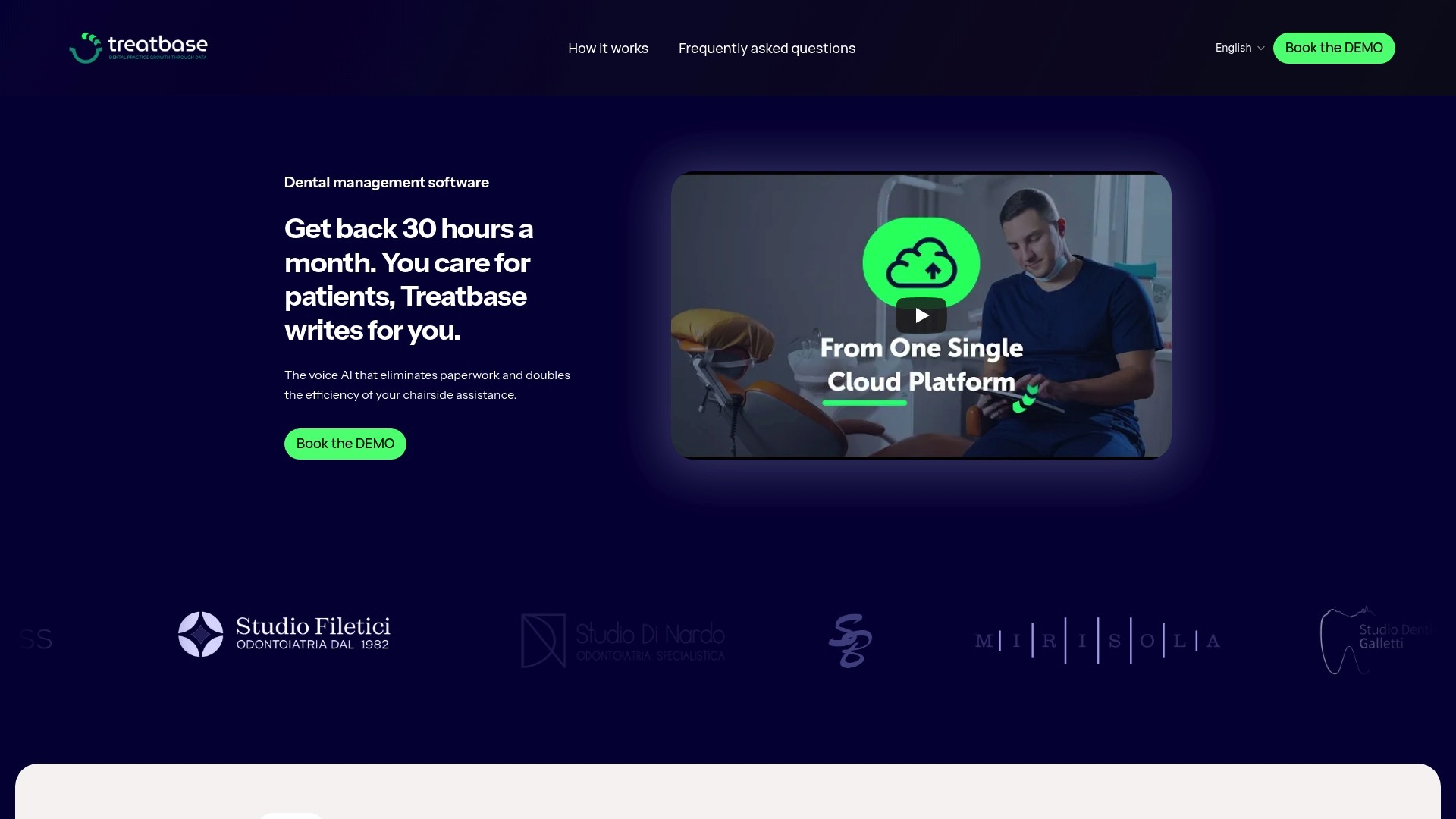
For Italian dental practices looking to reduce administrative burden without facing a major initial investment, some software programs offer voice automation features to eliminate manual transcription of clinical charts, include data migration, and integrate features designed for invoice and payment management.
Before requesting a demo, prepare some information that will help you obtain a precise and comparable quote against other gathered offers:
the number of chairs and locations of the practice, to calculate the applicable fee
the list of necessary integrations, in particular imaging and payment systems already in use
the modules you consider essential from day one, distinguished from optional ones
You can consult the Treatbase product overview to understand how functions connect with each other, or dive deeper into how financial management and practice situation control work, which is useful for building your return on investment estimate. To request a custom quote based on your number of chairs and integration needs, visit the Treatbase dental management software page.
Sources
Dental Practice Management: Software and Costs 2026 | Ivemind
Invoices for healthcare services and pre-filled declaration - Revenue Agency
Frequently Asked Questions
What is the best management software for dentists?
There is no single absolute best software: the choice depends on the number of chairs, the necessary integrations, and the desired level of automation. Treatbase stands out for the voice automation of clinical charts and free data migration, useful elements for practices wanting to reduce administrative workload without complex customizations.
Where can I find the price list for dental treatments?
The price list for dental treatments is defined by each individual practice and is not centralized or public data on a national level. For tax rules regarding the invoicing of these services, the official reference remains the Revenue Agency.
What is a good free management software for dentists?
Some multi-professional products offer free or entry-level plans suitable for newly opened practices, but they quickly hit limits in terms of functions and scalability as the practice grows, according to Ivemind's market analysis. For a practice with stable volumes, a paid SaaS plan with integrated compliance is generally more sustainable in the medium term.
How much is a dental practice worth?
The value of a dental practice depends on variables such as turnover, number of chairs, patient portfolio, and fixed costs, and requires a specific evaluation case by case. Management control based on benchmarks by number of chairs can offer an initial reference on the financial sustainability of the facility, as described in the analysis of costs by number of chairs.