Artificial intelligence in dentistry: what really changes in the clinic
Discover how artificial intelligence in dentistry speeds up diagnosis, simplifies management, and leaves the final decision to the dentist.

Artificial intelligence in dentistry: what really changes in the office
Today, artificial intelligence in dentistry is a diagnostic and management support tool, not a substitute for clinical judgment. It works well for reading X-rays, organizing the schedule, and reducing bureaucracy, but the final decision remains with the dentist. The immediate priorities for those who want to adopt it are threefold: understand where it brings real value (imaging, orthodontics, operational management), verify obligations regarding privacy and liability, and invest in training before relying on an automated system.
In brief:
The most consolidated applications of AI in dentistry concern the recognition of radiological images, such as caries, cephalometric landmarks, and implant plans, with accuracies still to be consolidated on a large clinical scale.
Automated management of schedules, reminders, billing, and electronic health records can significantly reduce daily time wasting, improving practice efficiency.
Compliance with the GDPR requires the dentist to maintain control over patient data, verifying transparency, accountability, security guarantees, and international data transfers.
The validity of AI systems strongly depends on the quality of the training datasets, and unsupervised use can lead to incorrect diagnoses or overestimations of the algorithm's capabilities.
For effective adoption, it is essential to develop critical interpretation skills, knowledge of performance metrics, and cybersecurity skills within the clinical team.
TreatbaseSimplifies your office managementTreatbase uses voice artificial intelligence to fill in medical records, manage invoices, monitor performance, and remind appointments.Discover Treatbase
Table of Contents
Where artificial intelligence really works in dentistry: clinical applications
How AI improves dental office management
What the GDPR says about the use of AI in the dental office
What are the limits and risks of AI in dentistry?
What skills are needed to adopt AI in the dental office?
How will AI evolve in dentistry in the coming years?
My perspective on how to adopt AI without illusions
Treatbase: office management designed to work with AI, not against it
Sources
Frequently Asked Questions
Where artificial intelligence really works in dentistry: clinical applications
Image recognition algorithms analyze panoramic radiographs, bitewings, and CBCT scans identifying patterns that would take more time or more experience to find with the naked eye. The technical operation is based on neural networks trained on thousands of images annotated by specialists: the system adjusts its parameters by recognizing where a cavity is present, where the alveolar bone ends, or where a specific cephalometric landmark is located.
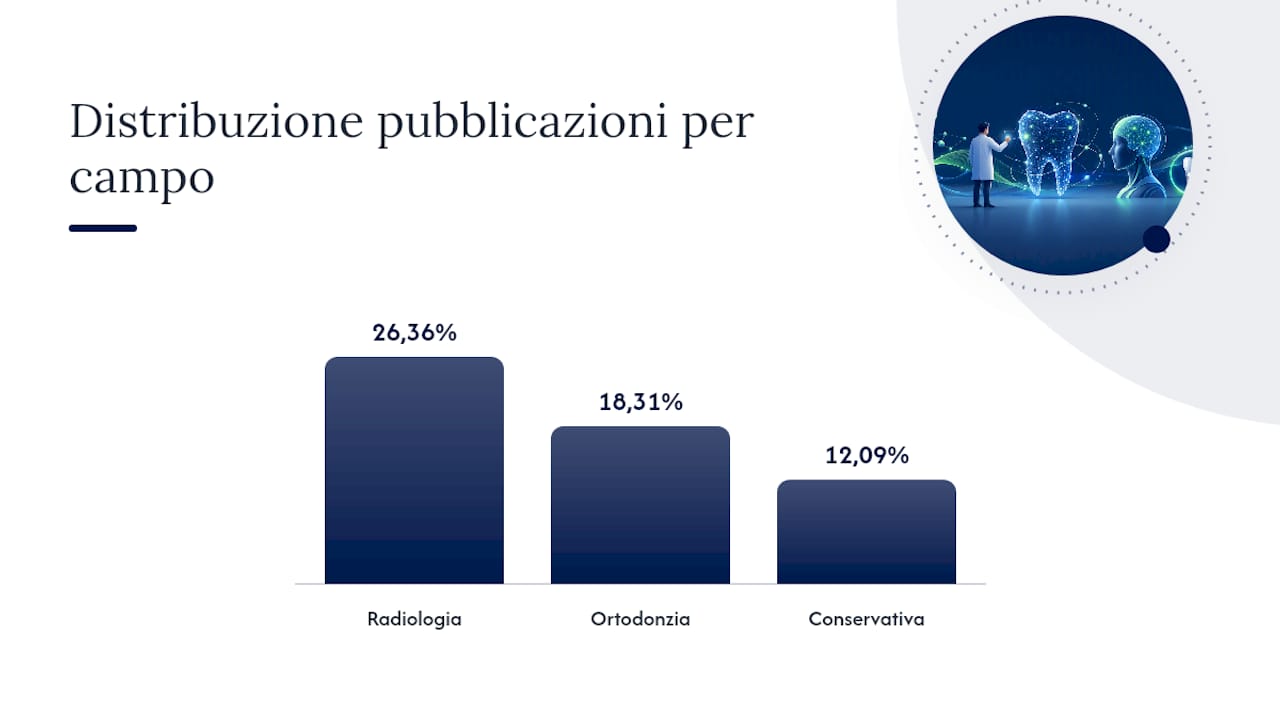
A broad review on the subject identifies the most mature fields of application: radiology, orthodontics, conservative dentistry, oral and maxillofacial surgery, and endodontics, with radiology alone representing 26.36% of scientific publications on the subject, followed by orthodontics (18.31%) and conservative dentistry (12.09%).
The concrete clinical applications available today include:
Automatic tooth-by-tooth segmentation on panoramic images, useful for planning multiple treatments without repeated manual measurements.
Detection of interproximal caries on bitewings, which are often harder to detect by eye due to overlapping structures.
Automated cephalometric analysis in orthodontics, with landmark placement for planning braces or orthognathic surgery.
Estimating working length in endodontics and recognizing root fractures on CBCT before they become clinically visible.
Implant planning simulations that overlay the intraoral scan with radiographic data to calculate implant inclination and depth.
Remote screening in teledentistry, where intraoral photos taken by the patient are analyzed to flag anomalies before the office visit.
The performance reported in the literature is solid overall, but should be read with close attention to the context in which it was measured.
A concrete fact: published reviews show high accuracies for caries detection, periodontal evaluation, and cephalometric landmark recognition. Encouraging numbers, but most of these studies are retrospective, conducted on controlled datasets, and not yet on a large scale under real clinical conditions.
This does not mean the results are useless: it means they should be considered as a support to reading, not as a definitive report. An algorithm that flags a possible interproximal caries with an 85% probability is giving an indication to verify, not a final diagnosis. Teledentistry fits into this picture as a natural extension: it allows for remote monitoring of orthodontic patients or a first screening before an urgent visit, reducing idle time in the waiting room.
How AI improves dental office management
If imaging is the clinical face of artificial intelligence, operational management is where the daily impact is felt first and most clearly. The difference between an office that wastes time on manual transcriptions and one that automates them is measured in hours, not marginal details.
The areas where automation brings immediate benefit are:
Automatic reminders via SMS or email, which reduce no-shows without requiring phone calls from staff.
Voice dictation of medical records during the visit, which eliminates hand-written transcription after each appointment.
Automated billing linked to the services provided, with fewer data entry errors and less time spent on bookkeeping.
Analysis of practice performance through dashboards showing revenue per treatment, schedule occupancy rate, and productivity per staff member.
Hands-free periodontal charting, useful during probing when the assistant is not available to type.
The time savings generated by these tools accumulate on a monthly basis: a practice that automates transcription, scheduling, and billing eliminates dozens of small interruptions per day, each of which distracts from the patient in the chair.
A tip: before adopting a voice system for medical records, test it for a week with a single operator and compare the filling-in time with the previous method. You can almost always see the difference in the first few days.
The analysis of operational KPIs, often overlooked, is probably the least visible but most useful benefit in the medium term: knowing which treatments generate the highest margins, which days of the week have the most cancellations, or which collaborator has the highest conversion rate on proposed treatment plans allows for management decisions based on real data, not impressions.
What the GDPR says about the use of AI in the dental office
Under the GDPR, the dentist who uses artificial intelligence systems remains the data controller of their patients' data, even when that data is processed by external software. This entails precise responsibilities that do not automatically transfer to the software vendor.
Points to verify before adopting an AI tool in the practice:
Data controllership. The professional remains responsible for the lawfulness of the processing even when the scan or radiograph is processed by a third-party algorithm, as highlighted by the regulatory analysis on privacy and AI regulatory boundaries in dentistry.
Transparency toward the patient. If AI participates in the diagnosis or treatment plan, the informed consent should explicitly mention it, updating the forms already in use in the practice.
Data transfer to third countries. Many software providers process data on servers outside the EU: it is necessary to verify that standard contractual clauses or other guarantees provided by the GDPR exist before sending images or records to cloud platforms.
Contractual documentation with the provider. The contract with the AI provider should specify where the data is stored, for how long, and with what security measures—elements to be attached to or referenced in the medical record.
Staying updated on these points is not just a matter of formal compliance: a dispute related to unauthorized data transfer can cost far more than a software subscription, in terms of fines and the practice's reputation.
What are the limits and risks of AI in dentistry?
The most concrete risk is not that the algorithm makes a mistake, but that the practice team trusts a result too much without verifying it. A model trained on poor-quality datasets produces poor-quality output, a principle known as garbage in, garbage out which applies even more to the clinical context than to general computing.
The main limits to know before relying on an automated diagnostic tool:
Much of the reported accuracy comes from retrospective studies on controlled datasets, not from prospective validations in real clinical conditions.
The risk of bias is real when the training dataset does not represent the variety of age, ethnicity, or image quality that the practice will encounter in everyday work.
Metrics such as sensitivity, specificity, and AUC must be read together: an algorithm with high sensitivity but low specificity generates many false positives, increasing unnecessary diagnostic work.
Some dental imaging products have obtained regulatory approvals in the United States, but not all tools available on the Italian market have the same level of validation.
Mitigation involves three concrete actions: testing the tool on typical cases in your practice before generalizing its use, always maintaining clinical supervision of the automated result, and conducting periodic audits by comparing AI outputs with confirmed diagnoses over time. Uncritical delegation of clinical judgment remains the highest risk, far more than the technology itself.
What skills are needed to adopt AI in the dental office?
The real bottleneck in adopting artificial intelligence in dentistry is not technological. It is the competence of those who must interpret it, as pointed out by the analysis on what really holds back AI adoption in dental practices: a good algorithm in the hands of a team that does not know its limits produces more harm than benefit.
The three skills to develop before introducing AI into the clinical workflow:
Critical interpretation of results. Understanding what an 85% probability score means and distinguishing a diagnostic support from a final diagnosis.
Basic understanding of datasets and metrics. Knowing how to read sensitivity, specificity, and understanding what kind of images the tool you are using was trained on.
Elements of cybersecurity and privacy. Knowing where the data sent to the software ends up and who has access to scans and X-rays.
An internal pilot project remains the most concrete way to test a tool without risks: setting a measurable goal, a duration of a few months, and criteria for comparison with current practice allows evaluating the real impact before expanding use to the entire practice.
A tip: assign the evaluation of the pilot project to a specific person on the team, not to "everyone a little bit". Without a clear owner, tests tend to stop after the first two weeks.
The guide on staff and performance offers a useful starting point for defining roles and permissions during the testing phase.
How will AI evolve in dentistry in the coming years?
The integration of clinical data and predictive capability is the most likely direction: systems that not only read an image but cross-reference patient history, habits, and response to previous treatments to estimate the progression of a pathology. Tools based on language models will grow mainly on the administrative and communication side, not on pure diagnostics. Clinical robotics will remain confined to experimental or academic settings for now. The condition for all this to become widespread practice is the same as it has been for years: shared standards and solid clinical validations, not just technological promises.
My perspective on how to adopt AI without illusions
The most common mistake I see is buying the technology before being clear about the problem it needs to solve. Priorities always remain the same: data security, team training, and a measurable pilot project before generalizing. Do not trust the accuracy percentages you read on a product datasheet: verify them in your practice, on your patients, with your data. Practical guides available online remain the most honest starting point for understanding what really works.
— Matteo
Treatbase: office management designed to work with AI, not against it
There are management solutions that allow you to apply the efficiency principles described so far without disrupting the daily workflow. Some systems use voice artificial intelligence to fill in clinical charts while you speak, eliminating transcription after each visit and automatically managing reminders, billing, and payments.
Unlike a traditional software change, which is often long and risky, data migration to these systems can be free and fast, with no hidden additional costs. Some offices report significant time savings in administrative work, time that becomes available for patient relations. Practical guides on scheduling and new patients and on payment management show step-by-step how it works in daily practice. Those who want to see how it integrates with their office can visit the Treatbase page and evaluate a direct trial.
Sources
Artificial intelligence in dentistry: application, prospects and challenges for a digital revolution
Frequently Asked Questions
What is the best artificial intelligence for doctors and dentists?
There is no single absolute best tool: the most validated imaging algorithms focus on cavities, periodontology, and cephalometry, while for practice management, schedule automation, voice transcription, and billing matter more.
What is a good management software for dentists?
A good dental practice management software should automate medical records, scheduling, reminders, and billing in a single system: Treatbase covers these areas with voice artificial intelligence and free data migration.
Is there a free dental software?
There are free solutions with basic scheduling and patient archiving features, but they rarely include voice automation, KPI analysis, or integrated billing: these features generally require subscription plans.
What are the applications of artificial intelligence in medicine and dentistry?
The main applications concern the reading of diagnostic images (radiographs, CBCT), support for orthodontics and endodontics, surgical planning, and, on the management side, the automation of scheduling, charting, and billing.
Can artificial intelligence replace the dentist in diagnosis?
No: available studies show good accuracies on specific tasks such as cavity detection or cephalometric analysis, but they remain support tools that always require the professional's clinical validation.