Speech recognition in dentistry: does it really work?
Discover how speech recognition in dentistry accelerates documentation, frees up your hands, and what human verifications and GDPR requirements are needed.

Speech Recognition in Dentistry: Does It Really Work?
Yes: speech recognition can speed up clinical documentation, but it requires configuration, human verification, and GDPR compliance. The immediate benefits are shorter compilation times, hands-free operation during procedures, and integration with the electronic health record and billing. The essential condition remains constant human review, because even the best systems produce clinically relevant errors on specialized terminology.
In brief:
Speech recognition significantly reduces clinical note compilation times, especially when integrated with continuous human correction systems.
The accuracy of the system depends on the microphone, environment quality, and background noise; thorough testing is essential before daily use.
The use of speech recognition systems requires strict compliance with GDPR regulations and the adoption of specific privacy and security measures, such as impact assessments and human-in-the-loop validation.
The WER and DWER metrics allow for the evaluation of clinical transcription accuracy, with DWER putting greater weight on critical errors in diagnostic and numerical terms.
Microphone choice and environment setup are fundamental to ensuring reliability, with a preference for wearable microphones and testing operational conditions in the presence of real noise.
Treatbasetreatbase.comFill in the chart by speaking. Treatbase uses voice AI to simplify dental management, from periodontal charting to the clinical record.Discover Treatbase
Table of Contents
Practical benefits of speech recognition for dental practices
Accuracy, technical limitations, and scientific evidence
Privacy, GDPR, and regulatory requirements for processing health data
Hardware, microphones, and environment: preparing the practice for reliable recordings
Practical checklist for choosing and implementing a speech recognition system
How Treatbase integrates speech recognition into practice management
Expert perspective on adoption and quality control
Direct option: how to get started with Treatbase
Frequently Asked Questions
Sources
Practical benefits of speech recognition for dental practices
Voice dictation shifts the burden of documentation from post-visit to during-visit. Instead of writing notes at the end of the day, the dentist dictates them while working, which reduces overall administrative time and leaves more room for patient interaction.
The most concrete uses in the office include:
Clinical notes dictated in real time during procedures, without interrupting manual work.
Hands-free periodontal charting, with probing depths recorded by voice while operating.
Automatic transcription of visits, with direct entry into the electronic clinical chart.
Direct link between dictation, billing, and automated patient reminders.
Pilot studies report significant reductions in clinical note writing time, according to the experimental results of the King’s College London study, provided that the transcription passes through a correction pipeline. By integrating dictation, billing, and clinical charts into a single workflow, practices can save a substantial number of hours per month.
Accuracy, technical limitations, and scientific evidence
Before relying on speech recognition in a dental practice, it is worth understanding how accuracy is measured. The WER (word error rate) measures the percentage of incorrectly transcribed words relative to the total. The DWER, a variation designed for clinical contexts, penalizes errors on diagnostic or numerical terms more severely, as these can alter the clinical meaning of a note.
Pipelines combining speech recognition (ASR) and language models (LLMs) can reduce the DWER and achieve single-digit WERs, but clinically significant errors persist even in the highest-performing systems.
This is the central point that emerged from the King’s College London study on ASR systems in dentistry: the variability between systems is substantial, and none completely eliminates the risk of error on tooth numbers, abbreviations, or anatomical locations.
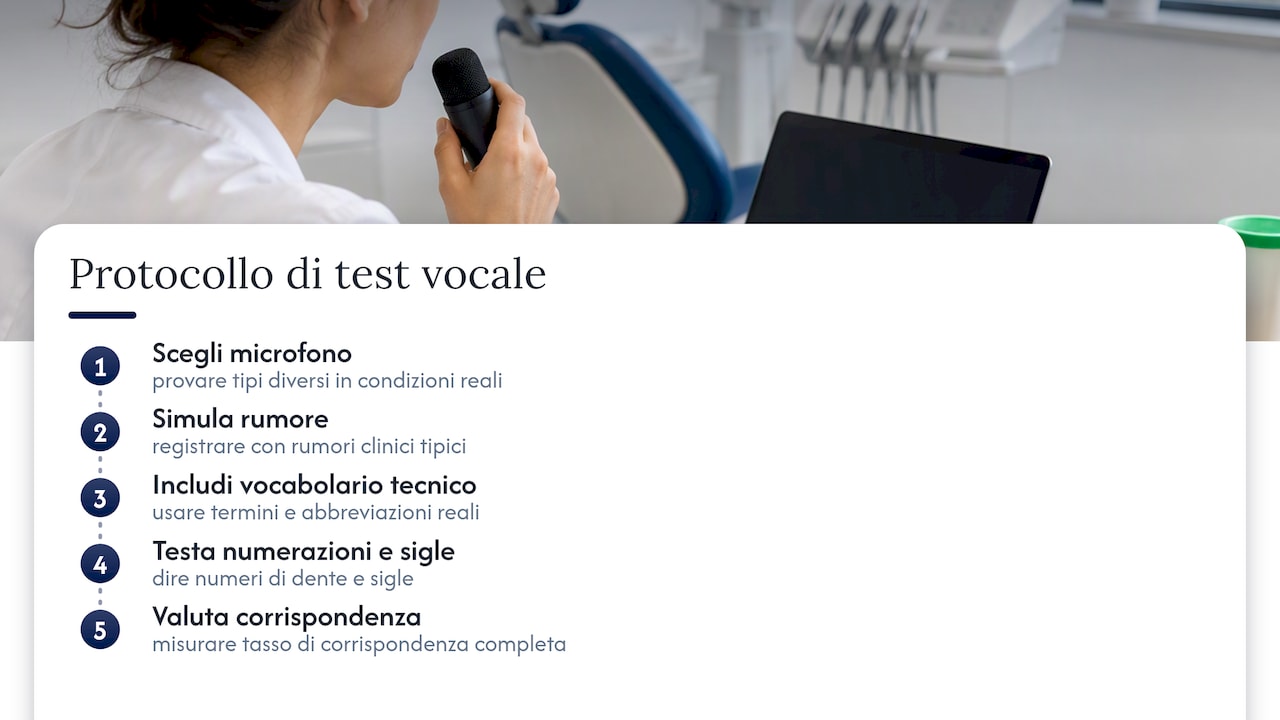
Microphone type and ambient noise heavily affect performance, to the extent that under non-ideal conditions, the complete match rate can be relatively low, according to a clinical evaluation on voice recognition for periodontal probing. Technical vocabulary and a noisy environment together degrade performance, so testing the system with real clinical sentences, including acronyms and dental tooth numbering, before the rollout is not an optional step.
Privacy, GDPR, and regulatory requirements for processing health data
Every time a speech recognition system transcribes identifiable clinical information, it enters the domain of health data governed by Article 9 of Regulation (EU) 2016/679, which prohibits the processing of these special categories of data unless specific legal bases apply.
For a dental practice adopting a voice solution, practical compliance steps include:
Checking whether the processing requires a data protection impact assessment (DPIA) under Article 35 of the GDPR.
Applying the principles of privacy by design under Article 25, starting from system configuration.
Maintaining a log of corrections and human reviews of clinical transcriptions.
Signing a data processing agreement (DPA) with the software vendor.
Defining policies for retention and encryption of voice and text data.
The Garante per la protezione dei dati personali (Italian Data Protection Authority) recommends strict technical and organizational measures for healthcare services based on artificial intelligence, including the human-in-the-loop principle: a person must always be able to verify and correct what the system produces before it becomes part of the official clinical record.
Hardware, microphones, and environment: preparing the practice for reliable recordings
The quality of the transcription depends as much on hardware as it does on software. A poorly chosen microphone can render even the most sophisticated speech recognition engine useless.
Prefer wearable pin-type microphones, which are more stable during dentist movements compared to stationary desk microphones.
Position the microphone close to the operator's mouth, away from noisy aspirators and rotating instruments.
Verify connection bandwidth and latency, which are critical requirements for cloud solutions that transcribe in real time.
Perform an audio test under real operating conditions, not in a quiet environment, before relying on the system during a patient visit.
A tip: record a test session with the aspirator and handpiece running: it is the only way to really know how the microphone behaves in the operatory.
Practical checklist for choosing and implementing a speech recognition system
Choosing a speech recognition system for the practice means evaluating precise technical criteria, not just the price or interface.
The essential criteria to check include:
Proven accuracy on dental-specific vocabulary, not just general language.
Native integration with the electronic health record system already in use.
Security measures and GDPR compliance documented by the vendor.
Ability to customize the clinical glossary with terminology such as SNOMED-CT.
The adoption path typically follows these phases:
Define specific goals: time reduction, hands-free charting, or both.
Test the system with a set of real clinical phrases, including tooth numbers and abbreviations.
Measure error rates and actual time saved during the pilot phase.
Train staff on correct microphone usage and correction procedures.
Proceed with a gradual rollout, department by department or operator by operator.
The Microsoft Azure Speech-to-Text APIs and similar enterprise cloud solutions allow for model adaptation and vocabulary customization, features that help reduce errors on specialized terminology during the testing phase.
How Treatbase integrates speech recognition into practice management
Within a management software, voice dictation can directly feed into the clinical record, charting, and billing within the same workflow.
Typical voice features include:
Filling out the patient record by voice during the visit, eliminating the need for subsequent manual transcription steps.
Hands-free periodontal charting, with probing depths recorded directly into the system.
Linking clinical dictation to billing, reducing duplicate manual entries.
Studies suggest that adopting such an integrated workflow can save significant hours per month, and data migration from the previous management software can be fast and free. To see how dictation fits into visit management, the visit management guide shows the operating workflow step by step.
Expert perspective on adoption and quality control
The transition from experimentation to daily use should only be decided after establishing acceptable error thresholds and a clear review workflow, not just after a convincing demo. Continuous training and periodic reviews of transcriptions matter more than the initial choice of vendor.
— Matteo
Direct option: how to get started with Treatbase
Those who want to try voice dictation without using a separate transcription system will find a single workflow in Treatbase: clinical record, periodontal charting, and billing updated by the same voice, at the exact moment of the visit.
To get started, we recommend to:
Request a direct trial on the Treatbase product page to evaluate the voice workflow in your practice.
Consult the Treatbase operating guides to understand how to configure the calendar, patients, and practice data before switching.
Verify the details of the free data migration before setting a launch date.
The price of the practice management software is available upon request directly from our team.
Frequently Asked Questions
Does speech recognition replace manual transcription in dentistry?
It significantly reduces the need for manual transcription, but it does not eliminate the need for human review. Practices adopting a correction pipeline achieve the greatest time savings, while a lack of verification increases the risk of clinically significant errors.
What do WER and DWER measure in a clinical transcription?
WER measures the overall percentage of incorrectly transcribed words, while DWER penalizes errors on diagnostic or numerical terms more heavily. Both metrics help compare different systems before a rollout, as shown by the King’s College London study.
Is a DPIA required to use speech recognition in the practice?
Often yes, because the processing involves health data governed by Article 9 of the GDPR. The impact assessment must be done on a case-by-case basis, considering the vendor, the system architecture, and the security measures adopted.
Which microphone is best to use for clinical dictation?
Wearable pin-type microphones tend to provide more stable results compared to stationary microphones, especially when the operator moves during the procedure. Testing the microphone in real noise conditions, with active aspirators and drills, remains the most reliable way to verify its performance.
Does Treatbase offer speech recognition for the clinical record?
Yes, our practice management software integrates voice dictation directly into the clinical record, periodontal charting, and billing. Pricing details are available upon request via the product page.
Sources
Decalogue for the implementation of national health services through Artificial Intelligence systems
Accurate clinical records are fundamental to dental practice (King’s College London study)