Reducing Bureaucracy in the Dental Practice: 2026 Practical Guide
Voice-recorded records, Health Card System (Sistema TS) invoicing, digital consents, reminders, and data migration: how to reduce bureaucracy in the dental practice, area by area.

Reducing bureaucracy in the dental practice: practical guide 2026
To reduce bureaucracy in the dental practice, you need to tackle the four areas where hours truly disappear: clinical chart completion, invoicing with data submission to the Health Card System (Sistema Tessera Sanitaria), collecting and archiving consents, and managing appointments, recalls, and collections. The principle is simple: stop writing the same information twice. In this guide, you will find, area by area, what can be automated, what must remain in the clinician's hands, and which Italian regulations must not be compromised while simplifying.
TreatbaseLess bureaucracy, more time for patientsTreatbase uses voice AI to simplify dental management, from clinical charts to invoices and automated reminders.Discover Treatbase
TL;DR
The heaviest bureaucratic burden is duplicate entry: notes at the chairside and transcription at the end of the day. Dictating the chart while you work eliminates the second step.
Invoicing private patients leaves no room for improvisation: those who submit data to the Health Card System cannot use the SdI. The practice management software must distinguish between patient and business on its own.
Digitally signed consents and automated reminders relieve the front desk, but the informative consultation remains yours and counts as time of care.
Switching practice management software is intimidating because of the data: clinical records must be retained indefinitely, so migration must be verified before shutting down the old system.
With AI, always ask the vendor how they handle health data: privacy by design, DPIA, human oversight.
Table of Contents
Where practice hours really go
Clinical records: dictating instead of copying
Invoicing: the SdI and Health Card System rule you cannot get wrong
Informed consent: digital yes, rushed no
Appointments, recalls, and no-shows
Treatment estimates, payments, and collections
Switching management software without losing data
Multi-location practices: one record, one invoicing method
AI and health data: questions to ask your vendor
A 30-day plan
Our perspective
Frequently Asked Questions
Sources
Where practice hours really go
Before buying anything, map things out honestly: for one week, everyone in the practice, including clinicians, tracks how many minutes they spend on non-care activities. Usually, the same items always emerge.
Activity | Who usually does it | What can be automated | What remains human |
|---|---|---|---|
Clinical chart and diary | Dentist, hygienist | Voice compilation, structured fields, procedure templates | Diagnosis, therapeutic choice, text verification |
Periodontal charting | Hygienist with assistant | Probe measurement recording via voice commands | The probing itself and its interpretation |
Invoices and data to the Health Card System | Front desk, accountant | Issuance from treatment plan, patient/business distinction | Exception handling, patient opt-outs |
Informed consent | Clinician and front desk | Digital signature, archiving, linking to the chart | The informative consultation |
Appointments and recalls | Front desk | Automated reminders, recall lists | Managing sensitive cases and emergencies |
Treatment estimates and collections | Front desk, office manager | Estimates from treatment plan, payment schedules, reminders | Consultation and discussion with the patient |
Practice reports | Practice owner | Dashboards on production, chair time, collections | Decision-making |
Effective simplification does not remove the professional from the process: it removes the steps where they are doing the work of a copyist.
Clinical records: dictating instead of copying
The classic bottleneck: quick notes during the appointment, transcribing into the chart at the end of the day. It is double work, and the second version is less accurate because it is written hours later.
Voice entry changes the sequence. The clinician dictates during or right after the procedure, the system converts the voice into structured text (tooth, procedure, materials, notes), and the clinician reviews and confirms. Three key practices make the difference:
Templates for recurring procedures. Hygiene, fillings, implant checkups: a template with pre-filled fields reduces dictation to only the variables.
Mandatory review before closing. The generated text is a draft until you validate it. Responsibility for the content remains yours, just as with any clinical record.
No improper delegation. Automating entry does not shift legal responsibilities. The Court of Cassation, with ruling no. 17164 of April 24, 2024, reaffirmed that procedures such as direct impression taking by a dental technician constitute unlawful practice of the profession. Software frees you from the keyboard, not from supervision.
Hands-free periodontal charting
Six points per tooth, probing depth, bleeding, recessions: with traditional methods, you either need an assistant taking dictation, or the hygienist takes off and puts on gloves for each quadrant.
With voice commands, the hygienist probes and speaks the values, and the system enters them in the correct spot on the chart. The assistant is freed up for other tasks, and transcription errors between paper and software disappear.
Invoicing: the SdI and Health Card System rule you cannot get wrong
Here, simplification must align with a specific regulation. According to the Italian Revenue Agency's FAQs on healthcare services, those who submit healthcare expense data to the Health Card System (Sistema Tessera Sanitaria) for pre-filled tax returns cannot issue electronic invoices via the Interchange System (SdI) for those services provided to individuals. This prohibition, established by Art. 10-bis of DL 119/2018 and Art. 9-bis of DL 135/2018, applies even if the patient has opted out of submitting data to the Health Card System.
In practice, the practice operates on two tracks:
Private patient: invoice outside the SdI and data transmitted to the Health Card System.
Company, institution, or other entity with a VAT number (for example, a service invoiced to a business): standard electronic invoice via SdI.
If the practice management software does not differentiate between the two cases automatically, the front desk must do it manually, invoice by invoice. Good software handles this seamlessly: the recipient is determined from the contact records, the invoice is generated from the completed treatment plan, and submission follows the correct path. For specific scenarios, such as associated practices with non-healthcare activities, the Agency issued guidance with ruling no. 103 of 2019: if your practice is in a similar situation, verify the setup with your accountant before automating.
Informed consent: digital yes, rushed no
Signing consents on a tablet and automatically archiving them in the patient's chart eliminates paper, scanning, and lost forms. But consent is not just an administrative formality to rush through in the waiting room.
Law 219/2017 establishes that communication time between doctor and patient constitutes time of care (Art. 1, paragraph 8), and the FNOMCeO guidelines on information and consent in implantology emphasize this exact principle for dentists. The Code of Medical Ethics entrusts informing the patient and obtaining consent to the physician (Art. 35).
The proper division of labor is therefore: software prepares the right form for the procedure, captures the signature, timestamps, and archives everything so it can be retrieved in seconds. You explain, answer questions, and give the patient time to read. In complex cases, such as implantology and surgery, have your legal-medical consultant review the forms.
Appointments, recalls, and no-shows
A missed appointment is bureaucracy in reverse: zero clinical work, but phone calls and empty schedule slots to fill. Automated reminders are the simplest countermeasure.
How to set them up effectively:
Two reminders, not one. One a few days ahead to allow time to cancel, and one the day before to confirm the time.
Easy cancellation. If cancelling is complicated, the patient simply will not show up. A timely cancellation is a slot you can reassign.
Recalls linked to the clinical record. The six-month hygiene recall or annual implant checkup must stem from clinical data, not the front desk's memory.
Short messages without clinical data. The practice name, date, and time are sufficient for a reminder. The procedure is unnecessary and, since it involves health data, is best omitted.
Treatment estimates, payments, and collections
In treatment estimates, clinical and administrative duties intersect, and information often gets lost: the clinician plans the treatment, the front desk re-enters it, and the invoice reflects yet another version.
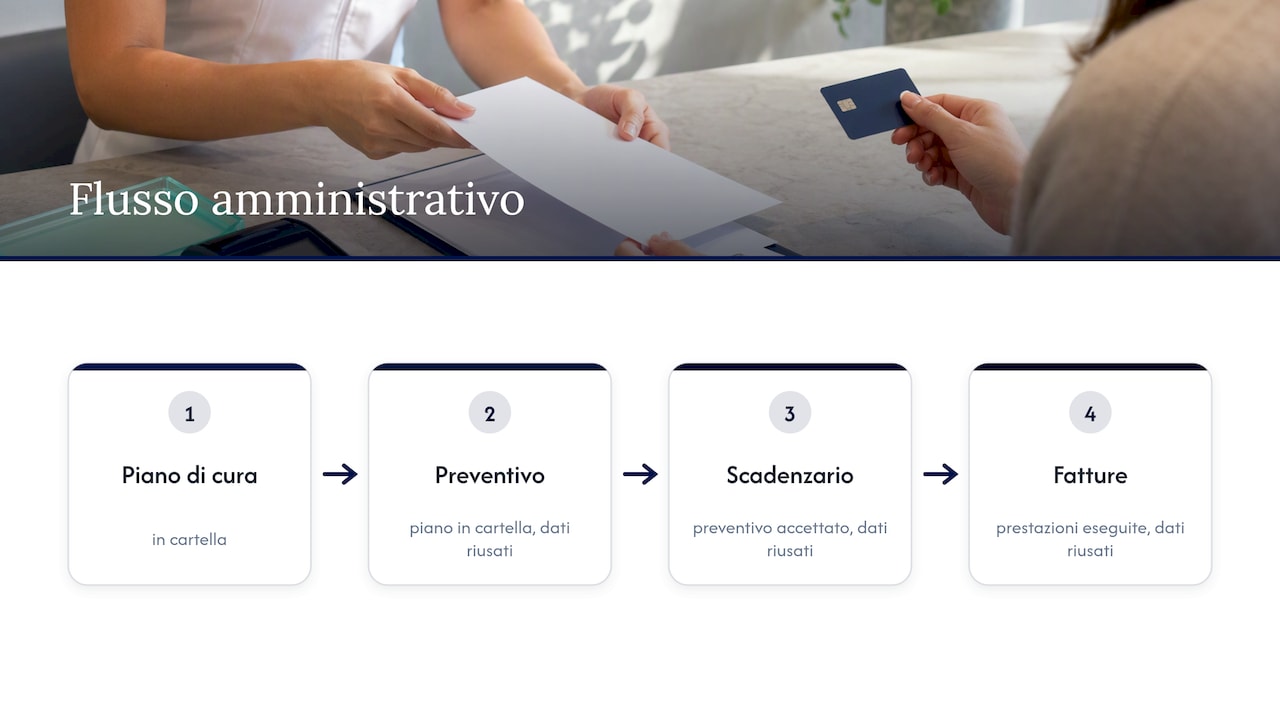
A clean workflow has a single source of truth: the treatment plan in the chart generates the estimate, the accepted estimate creates the payment schedule, and completed procedures generate the invoices. No one re-enters anything. The front desk immediately sees whose installments are due or overdue, and reminders can be sent with a single click. The practice owner, in turn, knows at a glance what has been produced, collected, and remains outstanding without asking anyone.
Switching management software without losing data
Many practices stick with an outdated on-premise system because migration feels daunting. It is a legitimate concern.
The Italian Data Protection Authority's factsheet on medical records points out that patients have the right to access their data and receive a copy (Art. 15 GDPR), and that the data controller must respond. Regarding retention, the Order of Physicians and Dentists of Messina cites the 1986 Ministry of Health circular stating that clinical records must be kept indefinitely, while a minimum of twenty years is indicated for X-rays. A migration that leaves data unreadable or incomplete is therefore a serious legal issue, not just a technical inconvenience.
A checklist for a smooth migration:
Export everything from the old system: demographics, charts, clinical notes, treatment plans, estimates, invoices, images, and signed consents.
Perform a sample test: select twenty patients with diverse histories—for example, an implant case, a periodontal case, and an orthodontic case—and compare field by field.
Verify dates and authors: every note must retain when and by whom it was created.
Keep the old database in read-only mode until you have thoroughly verified the migration, and preserve the original export.
Train the team before the switch, not on a Monday morning with a full waiting room.
Multi-location practices: one record, one invoicing method
In multi-location groups, bureaucracy grows exponentially because each site develops its own habits: varying chart templates, different consent versions, misaligned fee schedules.
Standardizing means centrally establishing chart templates, consents, price lists, and billing rules, leaving daily operations to the individual branches. Cloud practice management software with role- and location-based permissions makes this division tangible: the medical director sees everything, the hygienist sees their patients, and one clinic's front desk cannot alter the group fee schedule. For practices operating also in Switzerland or Spain, or those with multilingual teams, it is essential that the interface and documentation are available in the user's language.
AI and health data: questions to ask your vendor
Artificial intelligence is rapidly entering Italian companies: according to ISTAT, in 2025, 16.4% of enterprises with at least 10 employees were using at least one AI technology, compared to 8.2% in 2024. In a dental practice, however, AI handles health data, which GDPR treats as a special category: the Data Protection Authority clarified this in its guidance on processing health data.
The Data Protection Authority's Decalogue on healthcare services with artificial intelligence, published in October 2023 for the national healthcare system, outlines principles relevant to private practices as well: data protection by design and by default, data protection impact assessments (DPIA) for high-risk processing, and human oversight over decisions. Before signing, ask:
Where are data and voice recordings stored, and for how long?
Who acts as the data processor, and is there a written Data Processing Agreement under GDPR?
Does the vendor support you with an impact assessment if your DPO or privacy consultant deems it necessary?
Can the clinician always review and correct what the AI wrote before it is finalized in the chart?
Vague answers are a red flag. For decisions regarding your practice, your DPO or privacy consultant remains the ultimate reference point.
A 30-day plan
Week 1: measure. Map non-clinical activities as described above and identify the two biggest time sinks.
Week 2: streamline invoicing. Confirm with your accountant that the Health Card System / SdI routing is configured properly and that exceptions are clearly defined.
Week 3: charts and consents. Prepare templates for your ten most frequent procedures along with updated consent forms.
Week 4: schedule. Activate automated reminders and recalls, then track no-shows over the following month compared to the previous one.
Our perspective
To us, bureaucracy in dental practices is not solved by removing a single form: it is solved by ensuring every piece of information is spoken or written once, at the moment it originates, and then reused wherever needed. That is why we built Treatbase around voice: clinical notes are recorded by speaking, periodontal charting is completely hands-free, and estimates, invoices, and recalls flow directly from there without retyping anything.
We also believe the fear of migration traps too many practices on outdated tools that no longer serve them. That is why data migration is included in our service at no extra cost. And our core belief remains: the time that software saves should not turn into cramming more patients into an hour, but into spending more quality time with each patient. That is where trust is built, and where the practice protects itself best.
— Matteo
If you want to see how it works in your practice, discover Treatbase dental management software: voice-driven clinical charting, hands-free periodontal charting, invoicing, collections, automated reminders, digital consents, multi-user and multi-location management, and free data migration from your current system.
Frequently Asked Questions
How much time is saved by digitizing the practice?
It depends on how much duplicate entry exists today. An honest way to find out is to track non-clinical tasks for one week before making changes and repeat the same measurement one month later.
Can I send electronic invoices via SdI to private patients?
No. According to the Italian Revenue Agency, anyone transmitting data to the Health Card System cannot issue electronic invoices via SdI for healthcare services provided to individuals, even if the patient opted out of data transmission. The SdI is reserved for invoices issued to businesses and entities.
Does a voice-entered clinical record hold the same legal weight as a written one?
Its legal validity comes from the content and your validation, not from the input method. The text generated from voice must be reviewed and confirmed by the clinician, who remains responsible for it just like any other note.
What happens to data in the old management software after migration?
It must be migrated completely and verified, because clinical records must be retained indefinitely and patients have the right to access them. Keep the old archive in read-only mode and preserve the original export until full verification is complete.
Is an estimate signed by the patient legally binding?
An accepted estimate defines the financial agreement for the treatment plan, but plans may change during treatment. Document any changes with an updated estimate agreed upon with the patient, and consult your legal advisor for specific questions.
Sources
Italian Revenue Agency: invoices for healthcare services and pre-filled tax returns
Italian Revenue Agency: reply to ruling request no. 103 of 2019
Italian Data Protection Authority: clarifications on processing health-related data
Italian Data Protection Authority: Decalogue on healthcare services with artificial intelligence